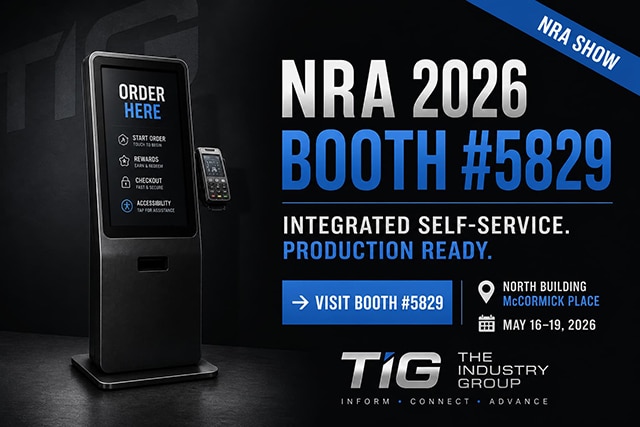
Heading to Chicago for the National Restaurant Association Show?
Make Booth #5829 in the North Building a priority stop.
The Kiosk Manufacturer Association (KMA) and The Industry Group (TIG) are showing real-world, deployed restaurant technology focused on capacity, accuracy,ADA, and AI-driven engagement.
Booth: #5829 Location: North Building, McCormick Place Dates: May 16–19, 2026
Why Stop Here – NRA Booth 5829 Preview Chicago
If you’re evaluating:
• Replacing or upgrading self-order kiosks
• Meeting ADA / accessibility compliance requirements
• Adding AI voice, vision, and personalization to ordering
• Securing unattended and payment-integrated systems
This is one of the few booths showing integrated, production-ready solutions — not concept demos.
Exclusive for NRA Attendees
We’re offering show-only access and discounts to TIG research tools used by operators and integrators:
• Retrofit vs. Replace Decision Kit with Worksheet
• ROI Calculator for Self-Service Investments
• Voice AI in Self-Service 2026: Drive-Thru, Kiosks & Real Costs v_10
• Edge AI Upgrade Planning Tools for Hailo / Intel / legacy systems
Designed to answer one question:
“Should we upgrade what we have — or start over?”
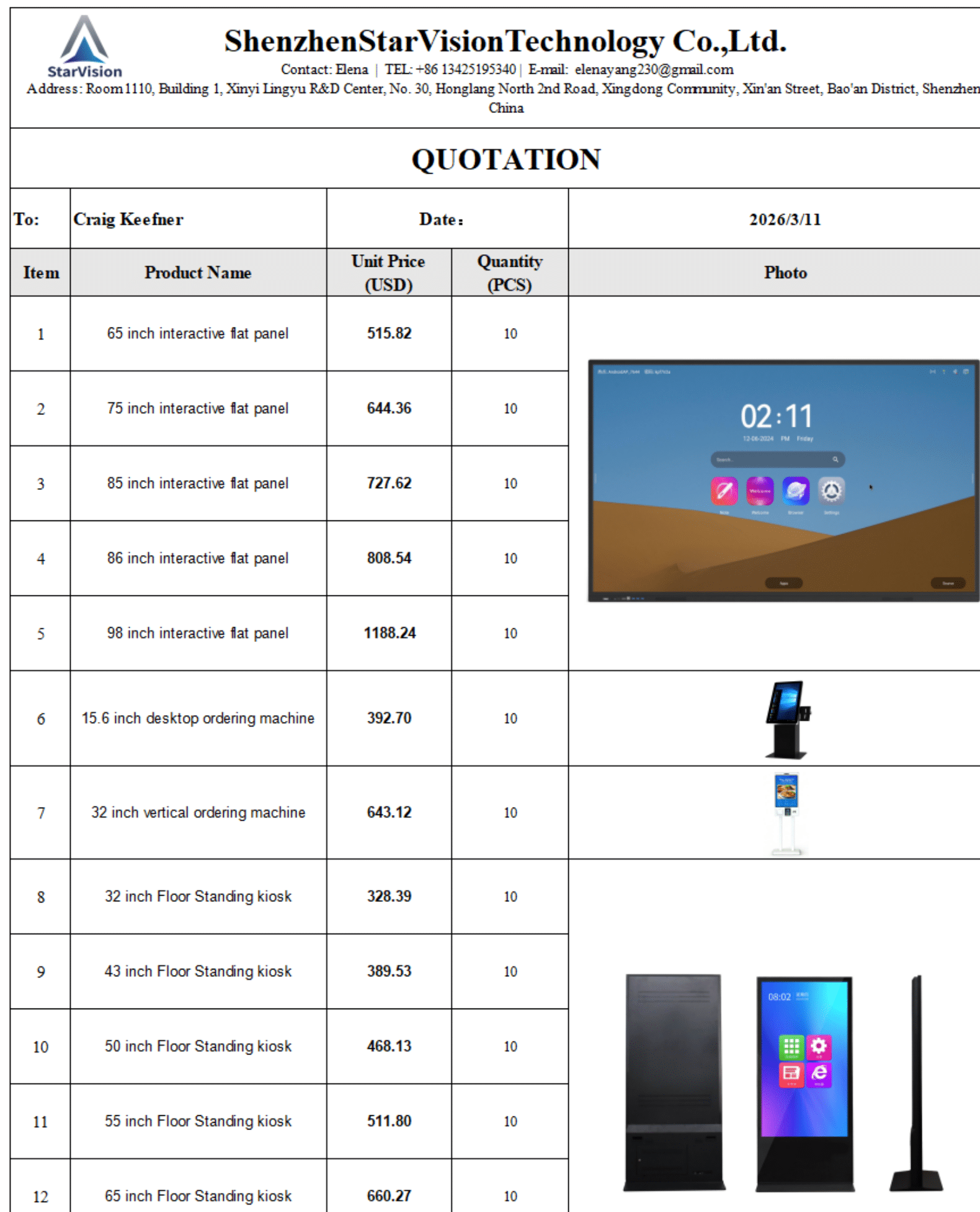
We work with Elena at StarVision and here is a profile.
It’s a pleasure to connect with you. My name is Elena, and we are a Chinese manufacturer of self-service terminals and interactive whiteboards. Following our interaction on LinkedIn, please find our company profile and product information in the attachment
Here is a concise executive summaryof the StarVision catalogyou uploaded:
StarVision – Company & Product Summary
StarVision (Shenzhen Star Vision Technology Co., Ltd.)is a Chinese manufacturer founded in 2014specializing in digital signage, interactive displays, and self-service kiosks. The company handles R&D, design, manufacturing, and salesof display and kiosk hardware used in commercial, educational, and public environments.
star vision catalog
Company Overview
Headquarters:Shenzhen, China
Manufacturing:Dongguan facility
Factory size: ~10,000 m² with dust-free production areas
Engineering:20+ engineers/technicians
Experience: ~10 years in display manufacturing
Global reach:Products used by 1,000+ brands worldwide
star vision catalog
The company emphasizes OEM/ODM manufacturing, allowing customers to rebrand or customize hardware designs.
Product Portfolio
1. Digital Signage Displays
Wall-mounted displays
Floor-standing displays
Typical specs:
Sizes: 32″–85″
Android 11 platform
4K UHD support
Capacitive or infrared touch
Built-in speakers
Ethernet / Wi-Fi connectivity
Includes CMS (Content Management System).
star vision catalog
Used mainly for:
Retail advertising
malls
public spaces
corporate communications
2. Interactive Flat Panels
Large interactive displays for education and corporate meetings.
Key specs:
Sizes: 65″–110″
Android 14 platform
20-point touch
Built-in camera and microphone
4K display
Wireless networking and front I/O ports.
star vision catalog
Typical markets:
classrooms
meeting rooms
collaboration environments
3. Self-Service / Ordering Kiosks
Compact kiosk systems designed for retail or food ordering.
Key specs:
Screen sizes: 15.6″ – 32″
Windows OS
Capacitive touch
Connectivity: USB, HDMI, Ethernet
Optional modules:
thermal printer
QR scanner
NFC
camera.
star vision catalog
These resemble standard QSR self-order kiosks.
4. Specialty Hardware
Additional devices include:
Mobile stand TVs
Livestream broadcasting kiosks
Smart interactive blackboardsfor education.
star vision catalog
Manufacturing & Quality
StarVision promotes a structured quality control process, including:
Testing:
vibration tests
high-temperature aging
humidity testing
drop tests
functional verification
Production capacity includes large format LCD backlight units (55″–110″) with high monthly volume capability.
star vision catalog
Target Industries
Products are marketed to multiple sectors including:
StarVision positions itself as a cost-effective OEM/ODM hardware manufacturerwith:
large factory capacity
strong R&D and patent portfolio
flexible customization
global distribution partnerships.
star vision catalog
Bottom line: StarVision is a typical Shenzhen display OEMproducing digital signage, interactive displays, and small self-service kiosks, primarily aimed at white-label or partner branding for global distributors and system integrators.
Healthcare kiosks are turning into hospital companions, transforming the patient journey.
Traditionally, healthcare kiosks were limited to check-in and administrative tasks. Today, they are becoming integrated systems that support patient navigation, identity verification, co-pay payment and medication access. This shift reflects a broader transformation in digital healthcare, where automation is used to improve both efficiency and patient experience.
Globally, healthcare systems are facing increasing pressure from workforce shortages and rising patient demand. Industry research indicates that more than 80% of healthcare leaders are investing in automation to address staffing challenges and improve care delivery.Philips
From Healthcare Kiosks to Hospital Companion Systems
Healthcare kiosks are no longer standalone tools. They are evolving into companion systems that integrate multiple functions.
A modern hospital companion typically includes:
Biometric identity verification
Real-time wayfinding and navigation
Automated pharmacy dispensing
Payment and insurance processing
Patient guidance and information services
These systems act as nodes, connecting digital healthcare platforms with real-world patient interaction.
Solving the Last Mile of the Patient Journey
One of the most critical challenges in healthcare is the “last mile” of care delivery—ensuring patients successfully complete their treatment process.
Medication Adherence
Medication adherence remains a global issue. In markets like the United States, a significant percentage of prescriptions are never collected, leading to increased readmission rates and higher healthcare costs.
Hospital companions address this through point-of-care dispensing, allowing patients to receive medication immediately after consultation. This reduces friction and improves treatment outcomes. Much different than the old written script or even the new “call it in” to your pharmacy.
Patient Flow and Wayfinding
Large hospitals are difficult to navigate, creating delays and frustration.
Integrated wayfinding systems within healthcare kiosks guide patients through complex environments, improving punctuality and reducing anxiety. These systems function similarly to indoor navigation platforms, helping patients move efficiently between departments.
Reducing Administrative Bottlenecks
Healthcare facilities frequently experience congestion at registration desks, payment counters, and pharmacies.
By automating front-end processes, hospital companions enable:
Reduced waiting times
Improved patient flow optimization
Lower administrative workload
Automation allows healthcare staff to focus more on patient care rather than repetitive tasks.
Technology Behind Hospital Companion Systems
The evolution of healthcare kiosks is supported by advances in multiple technologies.
AI and Computer Vision
AI enables:
Facial recognition for identity verification
Behavior analysis
Smart recommendations
IoT and Connected Devices
Sensors and connected systems allow:
Real-time monitoring of device status
Inventory tracking
Environmental control
Cashless Payment Systems
Modern healthcare kiosks support:
QR-based payments
NFC transactions
Digital wallets
Edge Computing
Companies such asIntelandNVIDIA are advancing edge computing solutions that enable real-time processing directly on devices, reducing latency and improving system responsiveness.
Global Adoption: From Asia to International Markets
The hospital companion model is gaining momentum globally.
In Asia, particularly in China and Singapore, healthcare kiosks are already deployed at scale, using AI, navigation, and pharmacy services into a single system.
Meanwhile, companies like Amazon are exploring healthcare kiosks in the U.S., focusing on prescription access and automation.
While Western markets emphasize privacy and regulation, Asian deployments highlight speed, integration, and scalability, offering a preview of future global healthcare infrastructure.
The Business Case for Healthcare Providers
For hospitals and healthcare systems, hospital companions deliver measurable value.
Operational Efficiency
Automation reduces administrative workload and improves staff productivity.
Revenue Retention
In-hospital dispensing helps retain pharmacy revenue that would otherwise go to external providers.
Patient Experience
Shorter wait times and better navigation improve patient satisfaction and engagement.
Throughput Optimization
Faster discharge processes increase hospital capacity and operational efficiency.
Challenges: Accessibility and Data Privacy
Despite the benefits, adoption of healthcare kiosks also presents challenges.
Digital Accessibility
Not all patients are comfortable with digital systems, particularly older populations.
Data Security and Compliance
Healthcare kiosks must comply with strict regulations such as:
HIPAA
GDPR
Secure authentication and data encryption are essential.
Trust in Automation
Patients must trust automated systems for identity and medication dispensing.
The Future of Healthcare Kiosks as Infrastructure
Healthcare kiosks are evolving into healthcare ecosystems.
Future developments may include:
AI-driven with diagnosis
Integration with telehealth platforms
Expansion into remote and community healthcare
Hospital companions will play a central role in connecting physical healthcare environments with digital systems.
Conclusion Hospital Companion
Healthcare kiosks are no longer simple check-in tools. As hospital companions, they are transforming the patient journey by integrating navigation, payment, and medication access into a unified system.
In a global healthcare environment shaped by labor shortages and rising demand, these systems offer a scalable solution.
The future of healthcare is not just digital—it is connected, automated, and centered around the patient experience.
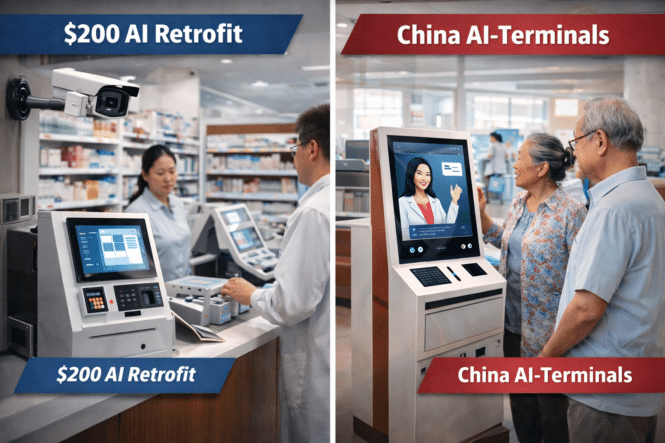
The “$200 AI Retrofit” strategy allows organizations to upgrade existing kiosks, cameras, and terminals with low-cost AI modules instead of replacing entire systems. In contrast, China is deploying AI-native smart terminals built from the ground up, integrating edge computing, sensors, and AI inference directly into new infrastructure.
Key Takeaway: Retrofit AI enables gradual modernization, while China’s AI-native terminals represent a leapfrog approach to intelligent infrastructure.
Two Different Paths to AI Deployment
Across industries such as healthcare, retail, and transportation, organizations are searching for practical ways to deploy artificial intelligence at scale. However, the strategies used in Western markets often differ significantly from those emerging in China.
Technology ecosystems involving companies such as Intel, NVIDIA, and the Self‑Service Industry Group have increasingly highlighted the concept of AI retrofitting—adding intelligent capabilities to existing devices.
Meanwhile, China’s national AI Plus initiative is accelerating the deployment of AI-native infrastructure, including intelligent kiosks, smart city terminals, and AI-enabled healthcare systems. According to recent policy reports, China’s core AI industry surpassed 1.2 trillion yuan in value in early 2026, reflecting a massive investment in next-generation digital infrastructure.
These two strategies represent fundamentally different approaches to the same challenge: how to scale AI across real-world systems.
Why Organizations Choose AI Retrofit vs AI-Native Systems
An AI retrofit is defined as the process of upgrading existing digital infrastructure with external AI modules, edge processors, or software overlays without replacing the original device.
For example, hospitals may add computer vision modules to existing patient kiosks, while retailers may attach AI edge devices to legacy self-checkout terminals.
By contrast, AI-native smart terminals are designed from the beginning with integrated AI capabilities, including GPU or NPU acceleration, sensors, and real-time analytics software.
Market Reality & Deployment Statistics
The global self-service technology market is experiencing rapid expansion as organizations integrate AI capabilities into kiosks and service terminals.
Recent industry projections indicate the following deployment scenarios:
Low adoption scenario:
20–25% of existing kiosks upgraded with AI retrofit modules by 2027.
Base scenario:
35–40% of self-service terminals incorporate AI edge processing.
At the same time, China is investing heavily in AI-native infrastructure, particularly in smart hospitals, intelligent retail environments, and urban digital services.
These deployments often involve entirely new generations of terminals capable of supporting computer vision, voice interaction, and biometric identification.
Implementation Checklist for AI-Enabled Terminals
Organizations planning AI integration typically evaluate several factors before choosing between retrofit and AI-native systems.
Key considerations include:
• Age of existing infrastructure
• Available capital expenditure budgets
• AI workload requirements
• Edge computing capabilities
• Data privacy and compliance standards
In mature markets with large installed bases of legacy devices, retrofit solutions often provide the fastest return on investment. In rapidly developing markets, however, deploying AI-native terminals may offer greater long-term scalability.
AI Terminals and Retrofit Technologies
What is an AI retrofit module?
An AI retrofit module is a compact edge computing device that adds artificial intelligence capabilities—such as computer vision or speech recognition—to existing kiosks or terminals.
How much does an AI retrofit typically cost?
Entry-level AI retrofit modules can cost around $200–$500 per device, depending on processing capability and sensor integration.
Why is China investing in AI-native terminals?
China’s AI Plus initiative emphasizes large-scale deployment of intelligent infrastructure, enabling industries to deploy AI-optimized hardware from the start.
Are retrofit solutions replacing traditional kiosks?
No. Retrofit solutions extend the lifespan of existing kiosks, while AI-native terminals represent the next generation of self-service infrastructure.
Conclusion
The global transition toward AI-enabled infrastructure is unfolding through two parallel strategies. The retrofit approach enables organizations to modernize existing systems at lower cost, while the AI-native model focuses on building entirely new intelligent platforms.
Together, these approaches illustrate how industries can move toward large-scale AI adoption while balancing efficiency, cost, and technological innovation.
Embedded World 2026, one of the world’s most influential exhibitions for embedded systems and industrial computing, took place from March 10–12, 2026 in Nuremberg Messe.
At the event, Giada Technology presented its latest embedded computing and industrial hardware solutions designed for digital signage, industrial automation, and intelligent edge applications.
The exhibition provided an opportunity for Giada to connect with global partners, system integrators, and technology innovators while demonstrating how embedded computing platforms continue to support the next generation of intelligent devices.
Showcasing Advanced Embedded Hardware Platforms
During Embedded World 2026, Giada showcased a range of embedded computing systems designed for reliability, scalability, and industrial performance.
Among the highlights was the Giada D108, an embedded x86 system powered by AMD Ryzen processors. The platform supports up to four HDMI 2.0 outputs, making it well suited for multi-display environments such as digital signage networks, monitoring centers, and control rooms.
The compact system design and high-performance architecture allow it to support demanding visual workloads across commercial and industrial environments.
Industrial-Grade Carrier Boards and Edge Computing Modules
Giada also demonstrated several industrial carrier boards designed to support both ARM and x86 computing architectures.
These boards support a wide range of industrial interfaces, including:
HDMI
LVDS
EDP
Such connectivity allows the systems to integrate easily with industrial displays, medical equipment, and intelligent kiosks, expanding their applicability across different vertical markets.
Additionally, Giada presented SMARC modules based on Rockchip and NXP platforms, designed for embedded IoT applications requiring long lifecycle support and stable performance.
These modules are capable of operating in extreme industrial environments ranging from –40°C to 85°C, making them suitable for factory automation, transportation systems, and edge AI deployments.
Edge AI and Intelligent Device Applications
Another focus of Giada’s exhibition presence was the role of embedded systems in enabling AI-driven edge computing.
The company presented an Android-based industrial PC with integrated NPU, designed to support machine vision applications such as:
automated defect detection
equipment condition monitoring
industrial quality inspection
These capabilities demonstrate how embedded computing platforms are increasingly becoming the backbone of smart factories and intelligent edge infrastructure.
Expanding Applications Across Retail and Hospitality
Beyond industrial use cases, Giada’s solutions are also widely applicable in commercial environments.
Embedded computing systems displayed at the exhibition support applications including:
digital signage networks
self-service kiosks
retail analytics systems
hospitality service terminals
With compact designs, low power consumption, and high reliability, these systems provide the computing foundation for next-generation self-service and smart retail deployments.
Strengthening Global Partnerships
Participation in Embedded World highlights Giada’s commitment to strengthening collaboration with global partners and expanding its presence in international markets.
By working closely with distributors, system integrators, and solution providers worldwide, Giada continues to develop embedded platforms that meet the evolving needs of industrial and commercial customers.
Looking Ahead
As embedded computing becomes increasingly central to industries such as industrial automation, digital signage, AI edge computing, and smart retail, companies like Giada are helping shape the infrastructure behind intelligent devices and connected environments.
Embedded World 2026 once again demonstrated how advances in embedded hardware platforms are enabling new possibilities across industries worldwide.
About Kiosk Asia News — The self-service technology landscape across Asia is undergoing a massive transformation, driven by a shift toward high-performance edge computing and a tightening regulatory environment. As digital transformation accelerates in markets like Singapore, Japan, and India, the focus has moved beyond simple transactional kiosks to integrated, “Store-in-a-Box” architectures that leverage local processing power for immediate, data-driven customer interactions.
A primary driver of this evolution is the integration of Edge AI and Neural Processing Units (NPUs). By moving AI workloads away from the cloud and directly onto the kiosk hardware—utilizing advanced silicon from providers like Intel and Hailo—operators are achieving the low-latency response times required for sophisticated computer vision and voice recognition. This hardware-centric approach not only improves the user experience through faster interactions but also addresses growing data privacy concerns by keeping sensitive information on-site.
Parallel to these hardware advancements is a significant push toward “Retrofit ROI.” Rather than engaging in costly full-scale replacements of existing infrastructure, industry leaders are increasingly looking at modular upgrades. By modernizing internal components like motherboards and scanners while retaining the high-quality industrial enclosures, businesses can extend the lifecycle of their hardware assets, improve sustainability, and realize a faster return on investment.
Furthermore, the legal landscape for self-service in 2026 is becoming more complex. With the European Accessibility Act (EAA) and updated standards like HHS Section 504 and the Americans with Disabilities Act (ADA) setting global benchmarks, Asian manufacturers and deployers are prioritizing inclusive design. Ensuring that kiosks are accessible to all users—regardless of physical ability—is no longer a secondary consideration; it is a fundamental requirement for any technology entering the international market.
As we look toward upcoming industry events, such as NRF Singapore in June, the focus remains on building strategic technology partnerships. The goal is to create a seamless ecosystem where hardware, software, and compliance standards align. From digital signage to automated retail and healthcare patient portals, the self-service sector is entering a new era characterized by technical precision, accessibility, and robust, localized intelligence. This shift reflects a broader commitment to fact-based reporting and engineering-first solutions that define the current state of the industry.
Smart malls in Asia are pushing retail infrastructure to its limits. High foot traffic, real-time interactions, and always-on services are exposing a fundamental constraint in modern AI systems:
Cloud-based inference cannot keep up with physical-world latency requirements.
As a result, the industry is undergoing a structural shift:
From cloud AI → to edge AI inference
This is not a marginal improvement. It is a redefinition of how retail systems are built, deployed, and scaled.
The Problem with the Cloud: When Latency Becomes Revenue Loss
Cloud AI has long been the default architecture. But in high-density environments like smart malls, its limitations are increasingly visible.
Latency Kills Experience
Cloud-based processing introduces:
~200ms round-trip latency
Dependency on network stability
Edge AI reduces this to:
~15ms local inference
This difference directly impacts:
Facial authentication payments
Voice ordering systems
Real-time queue management
In retail, milliseconds translate into conversion rates.
A 200ms delay is perceived as friction. A 15ms response feels instantaneous.
Bandwidth and Cost at Scale
At small scale, cloud AI is efficient. At large scale, it becomes expensive.
According to The Business Research Company, the global edge AI retail market is projected to grow from $21.8B in 2025 to $81.7B by 2030, representing a 30%+ CAGR.
Meanwhile, data from Market Intelo shows that autonomous retail platforms are scaling rapidly, with tens of thousands of automated stores expected globally.
A real-world cost comparison highlights the shift:
Cloud model (500 stores): ~$720,000/month
Edge model: ~$249,500 hardware + ~$2,500/month
Payback period: ~11 days
At scale, cloud inference becomes a recurring liability. Edge AI becomes a capital-efficient asset.Data
Data Sovereignty and Compliance
Regulation is accelerating this transition.
Frameworks such as the General Data Protection Regulation and emerging AI regulations are restricting how data is processed and transferred.
Edge AI enables:
On-device processing of biometric data
Transmission of anonymized metadata only
Elimination of raw video uploads
In Europe, this is not a feature—it is a requirement.
Why Now: The Inflection Point of Edge AI
Three forces are converging to make edge AI viable at scale.
One of our APAC members is Best Kiosk. Kitty is the main rep and here is a nice article by her on outdoor kiosks
Kiosks have become very helpful tools for businesses. Whether placed indoors or outdoors, they are a flexible, affordable, and customer-friendly option for walk-in customers.
When comparing indoor vs outdoor kiosks, there are several advantages and disadvantages to consider. Deciding which one will serve you better will require proper research.
This article will help you understand the differences between indoor and outdoor kiosks and the best option for your business.
Kiosks are generally categorized into two types; indoor and outdoor, with each serving specific needs, environments, and business objectives.
Indoor kiosks are all about aesthetics and integration into indoor controlled spaces. Outdoor kiosks, on the other hand, are durable, highly visible, and convenient in open-air environments. Let’s explore these two types of kiosks.
Indoor Kiosks
Indoor kiosks are usually stationed in closed spaces within controlled environments, such as malls, airports, or large retail stores. They are ideal for businesses that need a compact yet visually appealing setup to attract foot traffic.
Indoor kiosks can be used for several things, including selling beverages, accessories, and fashion products. They are also used as snack outlets, coffee stations, and smoothie bars.
Apart from retail, they also serve as information centers for customer service, ticketing services, and self-service payment machines.
Outdoor kiosks are explicitly designed to resist environmental factors while maintaining their functionality and appeal.
Design ideas most often use weather-resistant materials, including steel, aluminum, and glass. Bold coloring and signage make them easy to recognize, while ergonomic layouts make them easy for customers and staff.
Key Differences Between Indoor and Outdoor
Indoor and outdoor kiosks are two very valuable tools for businesses. Their designs, features, and functionality differ greatly because of their intended environments.
Understanding the differences between indoor and outdoor will help you determine the correct type to suit your needs.
Environmental Durability
One of the most fundamental differences between indoor and outdoor kiosks is their environmental resistance.
Outdoor kiosks are specifically designed to bear extreme climatic conditions in the form of rain, heat, and strong winds. They are built using heavy-duty materials like reinforced steel, or aluminum that secure the kiosk and its items from damage.
Outdoor food kiosks, for instance, are located in parks and must have weatherproof roofing, good drainage systems, and UV-resistant coatings. These features enable them to function properly and look well-maintained even after a long time.
Indoor kiosks, however, have no such need for protection since they are stationed in controlled environments. Although they could be made from lightweight materials like polished wood or glass for their cosmetic appeal, these kiosks are designed more so for style and branding than durability.
Design and Aesthetics
Locations largely influence the design of a kiosk. Outdoor design ideas focus on visibility and functionality. Also, many modern outdoor kiosks have extensions like roofs and heating mechanisms for better comfort in extreme weather conditions.
Indoor kiosks primarily work on the integration of design with their surroundings. Their designs are mostly sleek, modern, and minimalistic to promote the aesthetic experience of their environment.
Sophisticated indoor kiosks provide facilities with advanced lighting, digital screens, and high-end materials to offer an appealingly professional ambiance.
Functionality and Access
Indoor and outdoor kiosks also differ based on their level of access and functionality.
Indoor kiosks are usually smaller, and their applications are specialized for things like retail sales, ticketing, or information services. They are sometimes confined to fixed business hours imposed by their host facility, like a mall or airport.
Outdoor kiosks, however, are for versatility and convenience. They are put in places where many people pass through a lot to attract impulsive buyers. They are also not limited by building regulations or operating hours.
Advantages of Indoor Kiosks
Indoor kiosks enable businesses to operate efficiently in controlled environments while maintaining a high level of customer engagement and efficiency.
There are benefits that make them perfect for certain types of businesses, and some of them are:
Controlled Environment Usage
One of the major advantages of indoor kiosks is that they operate in a controlled environment.
Since these kiosks are indoors, they do not face challenging weather-related factors like rain, strong wind, heat, or cold. This makes them ideal for businesses dealing in perishable or even luxury goods that can be affected by environmental factors.
With indoor kiosks, businesses will spend less on weatherproofing or maintenance over long periods of time. This constitutes a key advantage in the indoor vs outdoor kiosks debate, where indoor setups stand out in providing a more predictable operational structure.
Greater Customizability
With indoor kiosks, you can customize your space based on the company and the kind of customers you want to attract. Since indoor kiosks don’t require weatherproof materials, more attention can be diverted to the aesthetic value and design of the kiosk.
Indoor kiosks usually have modern finishes, such as polished wood or glass, combined with interactive displays to engage customers. This full level of customization makes indoor kiosks ideal for immersive brand experiences.
Companies can play with layouts, colors, and lighting to invoke specific emotions or showcase new products.
Advantages of Outdoor Kiosks
Outdoor kiosks have become one of the most sought-after options among businesses looking to capture a bigger audience. Unlike indoor kiosks, outdoor ones are designed for maximum visibility, durability, and convenience in open spaces.
When looking at indoor vs outdoor kiosks, these benefits show how outdoor kiosks can fit you best.
Extended Accessibility
One advantage of outdoor kiosks is that they are easily accessible to customers. Unlike indoor kiosks, outdoor kiosks can remain open for longer, catering to the early riser and the late-night shopper.
Outdoor food kiosks set up on busy streets or concert venues, for instance, can serve consumers beyond regular working hours. Their ease of access makes them perfect for people who rely on impulse buying, like food kiosks or beverage stands.
Outdoor kiosks also have flexible layouts to make it easy and quick to conduct transactions on the go.
Durable Build for Harsh Conditions
The durable components used to build outdoor kiosks are an added advantage. These kiosks are specifically structured to endure extreme weather conditions, including heavy rain and heat.
Constructed using weather-resistant materials, outdoor kiosks are designed to remain functional and maintain their appearance over time. For instance, an outdoor food kiosk design will have features such as insulated panels, waterproof roofing, and sturdy frames.
Also, outdoor design ideas have specific features like anti-corrosion coatings and reinforced structures that guarantee long performance. These features lead to lower incidences of repairs or replacements, hence providing businesses with a cost-effective tool.
Choosing the Right Kiosk for Your Business
Given the question of indoor vs outdoor kiosks, businesses have to weigh their goals against operational environments and target audiences. The choice between an indoor or outdoor kiosk can have a great deal of influence on business success.
Assessing Location and Environment Needs
First, in choosing the right kiosk, you have to make an assessment of the location and environmental conditions for the operation of the kiosk.
Outdoor kiosks can offer outstanding visibility and accessibility, especially for businesses aiming to target open-air venues, public parks, or streets. These kiosks are designed with long-lasting materials and can endure extreme weather conditions.
Indoor kiosks, on the other hand, thrive best under controlled conditions found in malls, airports, and office complexes. These places have a consistent flow of people, making indoor kiosks ideal for businesses that operate in such environments.
Indoor kiosks also benefit from their host facilities for infrastructure such as air conditioning, security, and power supply, hence reducing operational costs.
Considering User Engagement and Accessibility
Outdoor kiosks are set up in very strategic positions where they are easily seen to attract different kinds of customers. Their flexible designs propel impulse buyers by making transactions easy and fast.
Indoor kiosks can engage customers in a controlled environment, whereas outdoor kiosks can’t really give a personalized experience to the users. This is done by using interactive screens, self-service options, and sleek displays, among other technologies.
For instance, an indoor kiosk with touchscreens can be utilized by a technology company releasing a new gadget. This feature will give customers hands-on use, thereby arousing interest and perpetuating sales of the product.
Accessibility also tends to take center stage here. Outdoor kiosks usually operate for longer hours, while indoor ones are generally limited by the time their host facilities are open.
You must, therefore, consider these differences to ensure that kiosks align with your customer’s behavior and expectations.
Conclusion
Getting either an indoor or outdoor kiosk depends on your business needs, customers, and the operating environment. Start browsing outdoor kiosk design ideas or developing a custom indoor experience to move your business to the next level.
Smart vending machines are rapidly evolving into AI retail platform, transforming the future of automated retail systems and modern commerce.
For decades, vending machines were simple devices designed to sell snacks and beverages. Today, powered by AI, data, and automation, smart vending machines are no longer standalone machines but intelligent retail systems integrating payment, inventory management, and real-time analytics into a unified platform.
This transformation reflects a broader shift in retail infrastructure:
Past: vending machines = product distribution Present: AI + data + payment + logistics Future: distributed retail infrastructure
As retail continues to digitize, smart vending machines are emerging as critical nodes within a connected, data-driven ecosystem.
From Vending Machines to AI Retail Infrastructure
The evolution of vending machines is closely tied to broader changes in the retail industry.
Driven by rising labor costs, demand for convenience, and the growth of unattended retail, vending machines are being repositioned as retail infrastructure nodes within urban environments.
According to Statista, the global vending machine market continues to grow steadily, supported by increasing demand for automated retail solutions..linkedln At the same time, insights from McKinsey & Company highlight that automation and digital integration are becoming core drivers of modern retail transformation
This shift is redefining vending machines as part of a larger system rather than isolated endpoints.
What Makes Smart Vending Machines AI Retail Platforms
A modern vending machine is not just a device—it is a connected system.
The transformation into an AI retail platform is driven by the integration of several key layers:
AI and Computer Vision
Product recognition
Recommendation systems
Consumer behavior analysis
IoT Connectivity
Real-time inventory tracking
Device health monitoring
Environmental control
Cashless Payment Systems
Mobile payments
QR codes and NFC
Digital wallets
Cloud Platforms
Centralized data processing
Remote management
Multi-location coordination
A smart vending machine is no longer a machine—it is a system.
The Technology Stack
The rise of smart vending machines is supported by a rapidly evolving technology stack.
AI & Computer Vision
Technologies similar to those used by Amazon enable:
Automated product recognition
Frictionless checkout
Reduced reliance on manual interaction
IoT Sensors
Sensors monitor:
Inventory levels
Equipment status
Environmental conditions
Cashless Payment Infrastructure
Modern machines support:
QR-based payments
NFC transactions
Digital wallets
Edge Computing
Companies like Inteland NVIDIA are advancing edge AI solutions that allow:
Local decision-making
Faster response times
Reduced latency
Why Brands Are Turning Machines into Retail Platforms
The shift toward AI retail platforms is driven by strong business incentives.
JD connects vending machines directly to its logistics network for optimized operations.
Challenges: Cost, Maintenance, and User Experience
High Hardware Costs
Cameras
Sensors
Computing modules
Maintenance Complexity
Hardware servicing
Software updates
Connectivity management
AI Accuracy and Trust
Product misidentification
Payment errors
User trust issues
The Future of Smart Vending Machines as Retail Infrastructure
Looking ahead, smart vending machines will become core components of distributed retail networks.
Future trends include:
Integration with e-commerce
AI-driven personalization
Expansion into last-meter retail
Smart vending machines are evolving into retail infrastructure nodes within a connected ecosystem
Conclusion
Smart vending machines are no longer just automated sellers—they are becoming AI retail platforms that integrate hardware, software, and data into a unified system.
For the retail industry, this represents a shift toward distributed, intelligent, and automated retail infrastructure.
The future of retail is not centralized—it is data-driven, automated, and built on smart vending machines
When Does Healthcare Automation Become the Barrier?
Efficiency vs. Empathy: A Decade of Rapid Digitization
For ten years, the global healthcare mission has been clear: digitize or drown. From self-service registration kiosks and QR-code check-ins to automated payment platforms, hospitals have raced to eliminate administrative friction. The goal was noble—reduce wait times and streamline workflows to manage soaring patient volumes.
China has been the world’s “beta test” for this transformation. In urban centers, public hospitals have achieved near-total automation. Patients can theoretically book, pay, and access records without ever speaking to a human. But as we move into 2026, a glaring reality has surfaced: Efficiency for the provider does not always equal accessibility for the patient.
Did We Forget Someone? The 323 Million Person “Glitch”
As of early 2026, China’s population aged 60 and above has officially climbed past 323 million. While developers were busy designing sleek, minimalist mobile interfaces, they inadvertently locked out one of the largest demographic blocks on the planet.
For an elderly patient, a “seamless” QR-code workflow isn’t a shortcut; it’s a wall. When a hospital mandates a mobile-first approach, they aren’t just adopting tech—they are shifting the burden of labor onto the patient. This is the Digital Divide Paradox: The more we automate to improve “operational efficiency,” the more we risk disenfranchising the very people who need care the most.
The “Hospital Companion”: A Human Patch for a Software Bug
The most telling sign of UI failure is the rise of the “Hospital Companion.” These professionals are now a staple in Chinese healthcare, acting as high-touch navigators for the digital age.
Think of them as a human “override” for systems that are too complex. They assist with:
The Kiosk Hurdle: Navigating multi-step registration flows.
The Digital Maze: Guiding patients through departments based on app-driven routing.
The “Invisible” Bill: Managing digital-only payment processes that lack physical confirmation.
The existence of this industry is a direct indictment of current healthcare IT design. If a system requires a paid human guide to operate it, the system hasn’t been automated—it has been over-complicated. It proves that in healthcare, automation cannot exist in a vacuum; it requires a human safety net.
Designing for the 75-Year-Old, Not the 25-Year-Old Developer
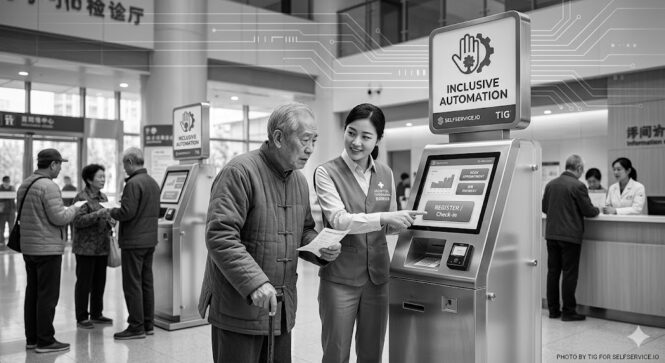
The shift we are seeing in 2026 is a move toward Inclusive Automation. For healthcare IT leaders and kiosk manufacturers, the mandate has changed from “How fast can we check them in?” to “How many can we check in without help?”
The Hybrid Mandate: Moving away from “mobile-only” to “mobile-first, kiosk-always.”
Cognitive UI: Implementing larger text, voice-guided interaction, and simplified, linear workflows that mirror natural conversation.
The Concierge Model: Reimagining the “Information Desk” not as a place to hand out maps, but as a digital support hub where staff help patients bridge the tech gap.
How Serious is The Global Regulatory Wake-Up Call?
The U.S. and European markets are watching. Unlike the rapid-fire deployment seen in Asia, Western markets are tethered to strict accessibility mandates like the Americans with Disabilities Act (ADA) and Section 508.
These aren’t just “compliance checklists”—they are blueprints for survival. A kiosk without audio assistance or a screen reader isn’t just a liability; it’s a broken tool. As global healthcare systems merge, the lesson from China is clear: Technology must adapt to the patient, or the patient will simply go elsewhere.
What’s The Bottom Line: Automation is the Tool, Not the Goal
The future of hospital automation won’t be won by the company with the flashiest app. It will be won by those who can blend high-tech efficiency with high-touch inclusivity. Success in 2026 is defined by Universal Access—ensuring that “frictionless” healthcare doesn’t leave the most vulnerable patients behind in the lobby.
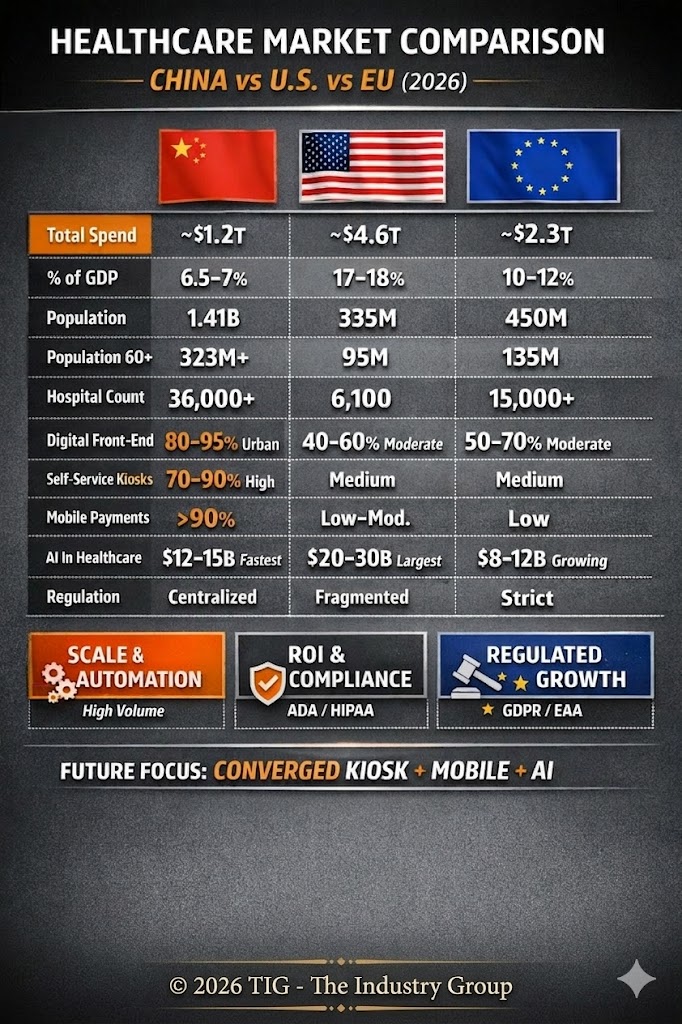
China Healthcare Market — Key Metrics (2026)
1. Total Healthcare Market Size
~¥8.5–9 trillion RMB ($1.2–1.3T USD)
CAGR: 6–8%
Driven by aging population + government investment
2. Population 60+ (Core Demand Driver)
323+ million people (2026)
Expected to reach ~400M by 2035
Largest elderly population globally → massive strain on access systems
3. Urban Hospital Digitization Rate
Tier 1 / Tier 2 cities: 80–95% digital workflow adoption
Includes:
Self-registration kiosks
QR-based payments
EMR integration
👉 China is arguably the most digitized hospital front-end system globally
4. Annual Outpatient Visits
~8.4–8.7 billion visits/year
High congestion → primary driver for:
kiosks
mobile check-in
queue management systems
5. Self-Service Penetration (Hospitals)
Large urban hospitals:
70–90% of transactions automated
Rural / lower-tier:
<40% penetration
👉 Massive tier-2/3 expansion opportunity
6. Digital Health Market Size
~$150–180B USD
Includes:
telemedicine
AI diagnostics
digital platforms
CAGR: 20%+
7. AI in Healthcare Market
~$12–15B USD (2026 est.)
Focus areas:
imaging diagnostics
triage systems
clinical decision support
👉 Heavy state backing → strategic sector
8. Hospital Infrastructure Scale
~36,000+ hospitals
~1 million+ primary care institutions
Large fragmentation → integration challenge + opportunity
9. Cashless / Mobile Payment Penetration
>90% of urban healthcare payments digital
Dominated by:
Alipay
WeChat Pay
👉 Enables fully unattended patient journeys
10. Government Healthcare Spend (% of GDP)
~6.5–7% of GDP
Still below OECD (~9–12%)
👉 Indicates continued expansion runway
TIG Executive Takeaway
China isn’t just scaling healthcare—it’s re-architecting the patient journey around automation.
Front-end = fully digitized, kiosk + mobile dominant
Back-end = AI + edge inference emerging
Weak spot = accessibility gap (elderly, rural)
👉 That gap is your next billion-dollar design problem: