
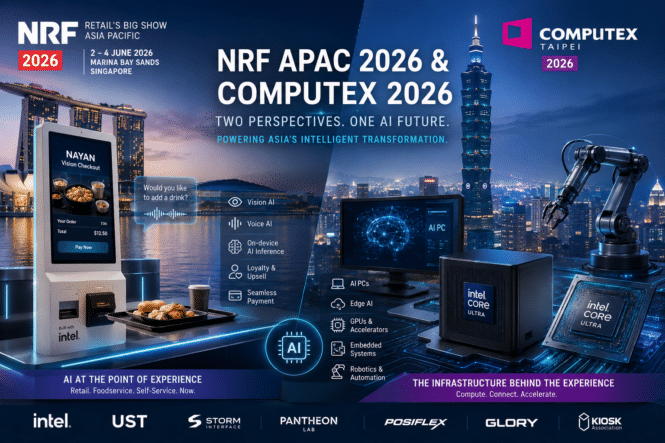
June 2026 will place Asia at the center of two major technology conversations. In Singapore, retail leaders, kiosk vendors, AI software companies, and self-service innovators will gather at NRF 2026: Retail’s Big Show Asia Pacific. At nearly the same time in Taipei, the global computing industry will converge at Computex 2026 to showcase the next generation of AI infrastructure, edge computing, semiconductors, and intelligent devices.
Although both events are rooted in AI transformation, they represent two very different perspectives on the future of technology in Asia.
NRF APAC focuses on how AI is changing customer-facing operations today — retail automation, foodservice workflows, digital commerce, kiosks, accessibility, and intelligent checkout systems. Computex, meanwhile, represents the foundational layer underneath those experiences: processors, AI PCs, GPUs, edge AI architectures, robotics, and embedded systems powering the next generation of enterprise technology. https://kioskindustry.org/nrf-singapore/
Together, the two events tell a larger story about how AI is moving from infrastructure to real-world deployment.
NRF APAC 2026: AI at the Point of Experience
Held from 2–4 June 2026 at Marina Bay Sands, NRF APAC 2026 carries the theme “The Next Now,” positioning itself as the meeting point for retail innovation across the Asia-Pacific region.
The event reflects a broader shift happening throughout retail and hospitality: AI is no longer experimental. It is increasingly operational.
This year’s exhibitor lineup highlights how retailers are deploying AI directly into customer interactions and store operations:
- UST Vision Checkout — Built on AI. Designed for impact. From AI models that learn to agents that act, UST technology solutions reimagine the enterprise, creating an intelligent foundation for an adaptive and responsible AI ecosystem with lasting business impact. Let’s build the future of AI together.
- Storm Interface – Keymat — Storm Interface designs and manufactures accessible, rugged human interface devices and self-service hardware, including ADA and EAA compliant keypads for kiosks and other public-use systems. Founded in 1986 in the UK, the company is recognized globally as a strategic accessibility partner, helping organizations deliver inclusive self-service experiences for people with disabilities.
- Pantheon Creatives Pte Ltd — We at Pantheon Lab Ltd. push the boundaries of reality. As a seasoned startup, we strive to foster creativity via the use of deep learning technologies that empower our clients to visualize and intellectualize their virtual machines. Bringing digital human synthesis to the mainstream, we help content creators and companies to shape a more creative and innovative media and marketing landscape.
- panachedigilife.com – Panache is a leader in the new-age AI & IOT technology solutions with a vision to align & utilize the ‘Make in India’ and ‘Atmanirbhar’ policy of the Government of India in the ICT & IOT Electronics domain. Panache offers solutions around Smart Computing Devices, Smart & AI based Digital Classrooms, Smart Asset Management, Retail IoT, Healthy Living Solutions, AV Display and Pen Display Solutions and other contract manufacturing OEM/ODM. Panache is an ICT & IoT devices design, manufacturing, distribution & services company with a vision of ‘Making Human Life Easy’ by way of constantly innovating in the space of technology.
- Intel
- More
- POSIFLEX
- GLORY
The show floor itself demonstrates where retail technology is heading: toward intelligent self-service systems capable of combining computer vision, conversational AI, automation, and edge inference into a single customer experience.
One of the notable demonstrations at the event will be NAYAN, a voice AI-enabled Vision Checkout platform developed by UST with Intel.
Built for foodservice environments, the platform combines:
- Computer vision for tray and item recognition
- Voice AI for customer interaction
- On-device AI inference powered by Intel Core Ultra processors
- Loyalty, upsell, modification, and payment workflows within a single interaction
The system is designed specifically for high-throughput retail and foodservice environments such as:
- Quick-service restaurants
- Mall food courts
- Corporate cafeterias
- Convenience retail formats
Rather than presenting AI as a future concept, NRF APAC increasingly showcases AI systems already designed for live deployment.
Computex 2026: The Infrastructure Behind the Experience
While NRF APAC focuses on operational deployment, Computex 2026 is expected to focus on the technologies enabling those deployments at scale.
Historically, Computex has served as one of Asia’s most important stages for:
- AI PCs
- Edge AI systems
- GPUs and accelerators
- Industrial computing
- Embedded platforms
- Robotics
- Intelligent displays
- Smart city infrastructure
If NRF APAC demonstrates how AI appears in stores, restaurants, and kiosks, Computex demonstrates the silicon, compute architectures, and edge hardware making those systems possible.
This contrast is especially relevant in 2026 because the industry is entering a new phase of AI adoption:
- 2023–2024 focused on generative AI experimentation
- 2025 focused on enterprise pilots
- 2026 is increasingly about operational deployment at scale
That shift places edge computing at the center of both events.
Retailers now want AI systems that are:
- Faster
- More private
- Lower latency
- More resilient
- Less dependent on cloud connectivity
This is why on-device AI inference and edge AI architectures are becoming central themes across both NRF APAC and Computex.
Intel’s Position Across Both Shows
One of the more interesting overlaps between the two events is the growing role of Intel in connecting AI infrastructure with real-world deployment.
At Computex, Intel’s messaging will likely center around:
- AI PCs
- Core Ultra processors
- Edge AI acceleration
- Enterprise compute platforms
- Industrial AI architectures
At NRF APAC, those same technologies appear in practical retail applications.
The UST NAYAN platform is a strong example of this transition from infrastructure to operational AI:
- AI models operating directly at the edge
- Real-time inference on production hardware
- Vision AI integrated into checkout workflows
- Conversational AI layered into customer interaction
This reflects a broader industry trend where AI hardware vendors are no longer selling only compute performance. Increasingly, they are demonstrating complete operational ecosystems.
Accessibility and Human-Centered Self-Service
Another important theme emerging from NRF APAC 2026 is accessibility.
Storm Interface will showcase rugged, accessible self-service hardware including ADA- and EAA-compliant keypads designed for kiosks and public-use systems. The company has become increasingly relevant as retailers and public venues rethink how self-service experiences accommodate broader customer needs.
Notably, Keymat will also be showing LG kiosk hardware integration at the event, highlighting how accessibility, kiosk design, and AI-enabled interaction are increasingly converging into a single deployment strategy.
This human-centered approach creates an interesting contrast with Computex:
- Computex emphasizes performance, architecture, and scalability
- NRF APAC emphasizes usability, deployment, and customer interaction
Together, they illustrate how AI maturity now depends as much on experience design as raw compute power.
Asia’s Expanding Role in AI Deployment
Both events also reinforce Asia’s growing importance in the global AI economy.
Singapore has become a strategic hub for:
- Retail innovation
- Smart city initiatives
- Enterprise AI deployment
- Digital infrastructure investment
Taiwan remains central to:
- Semiconductor manufacturing
- AI hardware
- Edge computing
- Global supply chains
The proximity of NRF APAC and Computex on the June calendar effectively creates a two-week snapshot of where enterprise AI is heading across the region.
One event focuses on the customer experience layer.
The other focuses on the compute layer underneath it.
Together, they reveal how quickly AI is moving from concept to operational reality across Asia-Pacific industries.
More Information
-
-
- Shenzhen Kiosk OEM & ODM Providers: How to Pick the Right Manufacturing Partner
- NRA 2026 – Come See!
- Hospital Companions: How Healthcare Kiosks Solve the Last Mile of Care
- Edge AI in Smart Malls: Why Inference Is Moving Out of the Cloud
- Smart Vending Machines Are Becoming AI Retail Platforms
- Self-Service Government Terminals: China’s Digital Public Services
- Autonomous Shopping Malls: The Future of Retail in China
-


