Contact Kiosk Asia
- craigkeefner@pm.me
- craig.keefner@gmail.com
- You can text Craig at 720-324-1837 (whatsapp or wechat)
- https://www.linkedin.com/in/kiosk/
If you’re serious about understanding where self-service is actually going—not just where Western vendors say it’s going—you contact KioskAsia.
Asia is not a “future market.” It is the current innovation lab for kiosks, unattended retail, digital payments, and AI-driven self-service. China, Japan, South Korea, and Southeast Asia are deploying at a scale and speed that simply doesn’t exist in the U.S. or Europe. From QR-native ecosystems to AI-powered vending and fully autonomous retail environments, Asia is setting the operational benchmark.
KioskAsia exists to decode that reality.
First, it provides ground-truth intelligence. Not recycled press releases or vendor marketing—but actual deployment examples, real use cases, and on-the-ground insights. If you want to know how smart vending is evolving into AI retail platforms, or how government self-service is scaling nationwide, this is where you start.
Second, it delivers strategic context. It’s one thing to see a kiosk in Shanghai—it’s another to understand why it works there and how (or if) it translates to U.S. or EU markets. KioskAsia bridges that gap, helping operators, manufacturers, and integrators make informed decisions instead of chasing trends blindly.
Third, it connects you to the right ecosystem. Asia’s self-service market includes manufacturers, component suppliers, AI firms, and platform providers that many Western companies don’t even know exist. Early visibility here can translate directly into competitive advantage—whether that’s sourcing, partnerships, or product roadmap direction.
Finally, it’s about speed and relevance. The self-service industry is compressing innovation cycles. What used to take five years now happens in eighteen months. If you’re not actively tracking Asia, you’re already behind.
Bottom line: Contact KioskAsia if you want signal over noise, execution over theory, and a clear view of where self-service is headed next.
China Database Vetted — note that the Asian companies are not quite so compliant with https
Giada Digital Signage Players https://www.giadatech.com Digital Signage media player, mini-PC, thin client
Smartelockers -Zhilai website All types of lockers
HavisTouch Interactive Whiteboards https://www.havistouch.com
BestKiosk – Custom Self-Services Kiosk Machine Manufacturer – https://www.bestkiosk.com Custom kiosks
MEKING POS TERMINAL https://www.mekingpos.com POS Terminals
Haxun Technology Co.,Limited https://www.szhaxun.com/ Embedded Computing
Flytech — POS systems — embedded computing and AIOs
KMYChina https://www.kmychina.com.cn Kiosks
CJTouch All In One Pc and Touchscreen https://www.cjtouch.com AIOs, Displays and Touchscreens
TOPWISE – the preferred POS for reliable & cost effective payment solution. http://www.topwisesz.com Cool Android
LITE-ON Technology Corporation https://www.liteon.com
Premier Car Head Unit Supplier – MCX electronics technology https://mcxcarplayer.com/ Talk with Lucky +86 13060624214
GLOSHINE — LED Display Screen & LED Wall Manufacturer | https://www.gloshine.com
Sinsecu Passport Reader https://www.sinosecu.com.cn
Usingwin Tech http://usingwin.com
GRGIntech – Cash Automation Solutions – http://www.grgintech.com
ECSUU http://www.ecsuu.com/
Rcstars: Digital Signage LCD/LED Interactive Touch Advertising Display/Screen Manufacturer http://www.rcstarsgroup.com
V-Series International/Vigit International – https://v-series.net/ https://vigitinternational.com/
Xyreon Technology – https://xyreon.com.my/
Generation X AI – https://www.genxai.com.my/
SNS Network – https://www.sns.com.my/
Aldan Technology – https://www.aldantechnology.com/
AOMAK aka AMH Digital Signage http://aomak.com
HYSTOU – Top Mini PC Supplier Manufacturer in 2024 | https://www.hystou.com
Lirsen Digital Displays http://lirsen-tech.com
BGLOPTO LED Technology http://bglopto.com
Creator Tech China https://www.china-creator.com/
Glory Star Group https://www.glorystargroup.com
BT Starts – Digital Signage https://btstarts.com/
Peacemounts http://www.peacemounts.com
NEXCOM Reliable Partner for the Intelligent Solutions https://www.nexcomusa.com/index.html
Horsent https://www.horsent.com
KYT Kiosk https://www.kytcloud.com
USER – LCD Video Wall, LED display, Digital Signage Solutions – Shenzhen User Special Display Technologies https://www.usersdt.net
Centerm Thin Client https://www.centermclient.com
CEO LED Transparent OLED https://ceoled-display.com
KINGTECH LCDs http://kingtechlcd.com
Yaham LED Display Manufacturer https://www.yaham.com/
aiyos-display https://www.aiyos.com
Dju-Tech Cameras https://www.dju-tech.com
深圳市易斯达信息技术有限公司,自助终端设备,智能访客终端,政务自助终端,银医自助终端,自助缴费终端,自助发卡终端,壁挂式自助终端,立式自助终
端,桌面自助终端,自助售票终端,自助查询终端,自助打印终端, http://Estar-kiosk.com
RisingStar LCD – Hi Brite LCDs http://risinglcd.com
IC Nexus Co., Ltd. SBC3500 – https://www.icnexus.com.tw/t_product/sbc3500/
Wintouch https://wintouchcn.com
Victory Digital Display https://www.victorydigitaldisplay.com
Tecnon Smart Display Technology Shenzhen Co., Ltd. http://www.leddooh.com
Yoda-Interactive Flat Panel Display http://www.szyoda.com
Injet – EV Charging of all types https://www.injetenergy.com
LCDKIOSK — LCD Display Screen-digital signage http://www.Lcdkiosk.com
Funpad – Touchscreen Computers http://www.funpad.com
Chainway Data Collection https://www.chainway.net/Products
Wis-view – Touchscreen Technology http://www.wis-view.com
Maken Kiosk https://makenkiosk.com/
DOTCOM LED Display https://dotcomled.com
Muxwave Holographic Invisible Screen – https://www.muxwave.com/
WiViKIOSK Technology Limited Outdoor KIOSK https://www.wivikiosk.com
Cashino Thermal Printer,Mini Printer,Pos Printer https://www.cashinotech.com
KeeTouch – Touchscreen Technology https://keetouch.en.alibaba.com/
Micron Touch Screens https://www.chinacts.net
Szusou LCDs https://www.szuzou.com
VIC Smart Display https://www.longithai.com
Unicorn Electronic locker https://unicorn-furnitures.com/product/electronic-locker/
Minix Official Store https://www.minix.com.hk
Newsmay Mini PC http://www.newsmaytech.com
HOK Autoparts – EV Charging Cable http://www.hokautoparts.com
Lifewatch — global video walls and digital signage professional manufacturer- https://www.lifewatch.com.cn
XGD – Payment Terminals http://www.xgd.com
Vast Vision – Touchscreen Technology https://www.vastvision.com.cn/About-Us.html
Toplink – Interactive Whiteboards http://www.itoplink.com/White_Board_/
Heystar – Self Order Kiosk https://www.heystarpro.com
Telpo Kiosks
Horsent PCAP touchscreen Monitor
BaoBao Industrial: Touch Screen Monitors http://www.baobaoindustries.com
Shiningltd https://www.shiningltd.com
aiyos-display https://www.aiyos.com
EKAA https://www.ekaa.net
Website at http://www.gzdesen.com http://www.gzdesen.com
Huaview : indoor and outdoor digital signage and kiosks
These companies are at the forefront of computer technology in Asia, offering a wide range of products from consumer laptops to high-performance gaming systems and business-oriented machines. Their specialization in computers has allowed them to compete effectively in the global market and drive innovation in the industry.
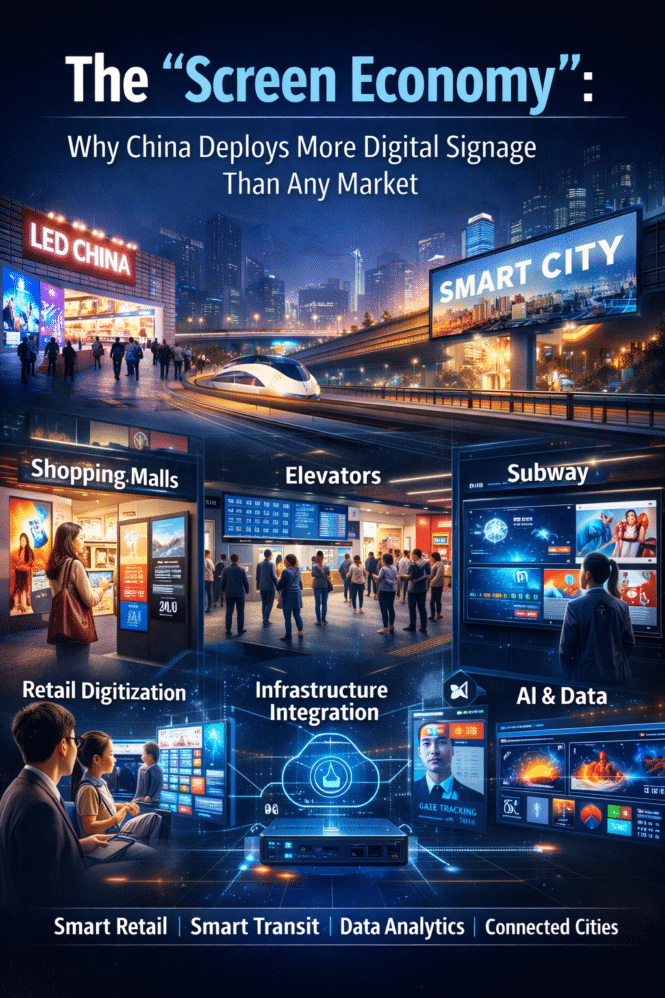
China is rapidly becoming one of the highest-density digital signage markets in the world—not just in scale, but in how deeply screens are embedded into everyday urban life.
Craig Allen Keefner comment — “As someone who’s watched the kiosk and digital signage market from both the US and Shenzhen, I think this piece captures a key point: in China, screens aren’t just ‘displays’—they’re infrastructure. Government‑backed urban projects, dominant domestic panel manufacturing, and fast procurement cycles mean DOOH and retail signage can scale at a speed Western integrators still find hard to match. The next competitive battleground is less about hardware price and more about software, data rights, and who controls the monetization layer on top of these nationwide screen networks.”
Walk through any major Chinese city and the pattern is unmistakable:
This is not just adoption—it is saturation. China is no longer experimenting with digital signage; it is operationalizing it at national scale.
The global digital signage market reflects this transformation. Valued at $31.09 billion in 2025, it is projected to reach $58.42 billion by 2033, growing at a CAGR of 8.2%.
While North America currently holds the largest revenue share (35.6%), Asia-Pacific is the fastest-growing region, with China at its core. Grandview
What differentiates China is not just demand—but deployment logic:
This creates a network effect: the more screens installed, the more valuable the network becomes.
China’s megacities—Shanghai, Shenzhen, Beijing—provide the ideal conditions for digital signage:
In these environments, screens outperform static advertising by delivering dynamic, real-time content to millions daily.
Retail is the largest application segment globally—and China is pushing it further.
Digital signage in retail can increase foot traffic by up to 24% [Rise], particularly when multiple screens are deployed. Chinese retailers leverage this through:
This aligns with China’s broader “New Retail” strategy—where physical stores act as data-driven media environments.
Unlike fragmented Western markets, China benefits from top-down digital infrastructure planning.
Initiatives such as the Digital Silk Road extend beyond connectivity—they enable:
Subways, stations, and airports rely heavily on video walls (25.5% market share) for:
In cities like Tokyo this is already critical—but China is scaling it faster and broader.
China’s dominance is also technological:
These systems are powered by:
The result is not just display—but intelligent signage networks.
Technology Stack for Mini-PC and Media Players
A key indicator of China’s leadership is its industrial ecosystem—anchored by events like LED CHINA.https://www.ledchina.com/
Its “Spring and Autumn Dual Exhibition” strategy integrates multiple sectors:
This reflects China’s “1+N industrial synergy model”—where signage is not standalone, but part of a broader visual communication ecosystem.
Digital signage in China is no longer just about ads. It is evolving into multi-functional digital infrastructure:
Retail stores are becoming mini broadcasting stations, running programmatic campaigns based on:
Interactive kiosks streamline:
Reducing labor costs while improving user experience.
Advanced systems now include:
This turns screens into data sensors, feeding back into marketing and operations.
Innovations like E Ink-based signage (e.g., low-energy ePosters) highlight a shift toward:
China represents both:
As global markets move toward integrated, data-driven signage networks, China is not just participating—it is setting the pace.
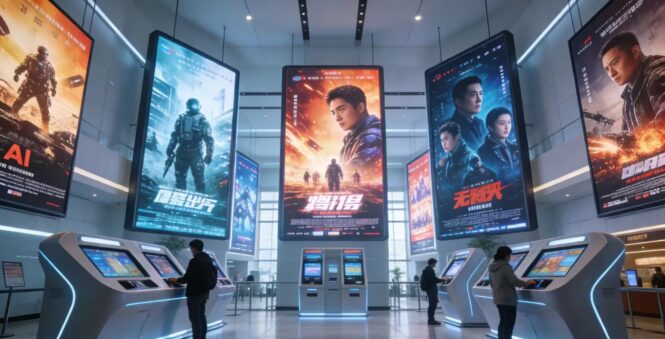
The Smart Cinema in China industry is undergoing a rapid transformation—from traditional exhibition spaces into fully digitized, self-service, AI-driven environments. On the computer side note the shift toward Intel Core Ultra (NPU-equipped) mini-PCs inside these kiosks to handle real-time demographic recognition and gaze analysis without high latency or massive cloud egress costs.
By Craig Allen Keefner — China’s cinema industry is quietly becoming one of the most advanced real-world deployments of integrated self-service infrastructure at scale. What looks like a simple ticketing upgrade is actually a full-stack transformation—combining kiosks, mobile, AI inference, and cloud orchestration into a unified operating model.
At the front end, self-service ticketing terminals have largely eliminated traditional box office friction. Customers select seats, pay, and retrieve tickets (or QR credentials) in seconds. More importantly, these systems are not standalone—they are tightly integrated with mobile apps, loyalty platforms, and real-time pricing engines. This is not “kiosk as device.” This is kiosk as endpoint in a larger digital ecosystem.
The bigger story is in the lobby. Digital signage and AI-enabled media players are turning idle space into a programmable revenue channel. Content is dynamically adjusted based on time of day, audience composition, and local demand signals. With edge AI (including platforms aligned with Intel’s Core Ultra direction), inference can be done locally—reducing latency, improving uptime, and addressing data control concerns.
Operationally, the model drives measurable outcomes: reduced labor dependency, higher concession attach rates, and improved throughput during peak periods. But the strategic shift is more important—cinemas are evolving into data-driven retail environments, where every interaction is captured, analyzed, and monetized.
The takeaway for operators globally is straightforward: China is not experimenting—it is operationalizing at scale. The cinema is no longer just a venue. It is a digitally managed, self-service platform—and increasingly, a high-margin media and data business.
Driven by large-scale adoption of ticketing terminals and AI-powered digital advertising screens, cinemas are evolving into high-efficiency, data-driven commercial spaces.
At the center of this shift are platforms like Alibaba Pictures, which are integrating SaaS systems, automation hardware, and AI marketing into a unified operational model.
China’s cinema market provides the foundational condition for this transformation: massive offline traffic.
This level of foot traffic creates a high-value environment where:
Without this scale, such investments would not be economically viable.
Chinese cinemas have widely adopted self-service ticketing terminals, enabling:
These systems are no longer standalone kiosks—they are part of a connected operational infrastructure.
With AI integration, ticketing terminals now support:
According to industry estimates, automation through self-service terminals can reduce up to 60% of front-desk labor costs, while significantly improving peak-hour efficiency.
The next phase of cinema digitalization is defined by AI.
By 2026, the global AI market in cinema operations is projected to reach $1.72 billion, driven by:
AI is no longer a backend optimization tool—it is becoming the core decision-making layer across cinema operations.Researchandmarkets
One of the most important upgrades inside Chinese cinemas is the shift from traditional posters to AI-powered digital advertising screens (media players).
These systems are increasingly integrated with:
This enables cinemas to deliver programmatic DOOH (Digital Out-of-Home) advertising.
We should note that while these systems use computer vision for demographic recognition, they are designed with on-device processing to comply with China’s strict data security and algorithm filing requirements.
The most valuable advertising window in a cinema is often overlooked:
the 3–5 minutes when users interact with ticketing terminals or wait in the lobby.
During this time, AI systems can:
According to industry reports, AI-driven marketing systems in China have improved ROI by up to 300%, with over 50% of advertisers already integrating AIGC into routine campaigns.DCHBI
This transforms cinema lobbies into:
High-precision, high-conversion advertising environments
The real breakthrough in China’s smart cinema model lies in system-level integration.
Solutions like “Fenghuang Yunzhi” from Alibaba Pictures demonstrate how cloud platforms can unify:
This creates a centralized SaaS control layer that enables:
The result is a cinema lobby that can operate with minimal or even zero on-site staff.
China’s cinema density and audience volume create a perfect environment for:
Self-service terminals are tightly integrated with mobile payment ecosystems, especially Alipay and WeChat.
This enables:
Payment friction—one of the biggest bottlenecks globally—is effectively eliminated.
China’s advantage is not just adoption—it is integration.
Instead of fragmented systems, leading operators deploy:
This “full-stack” approach ensures that every device—from kiosks to screens—works as part of a single system.
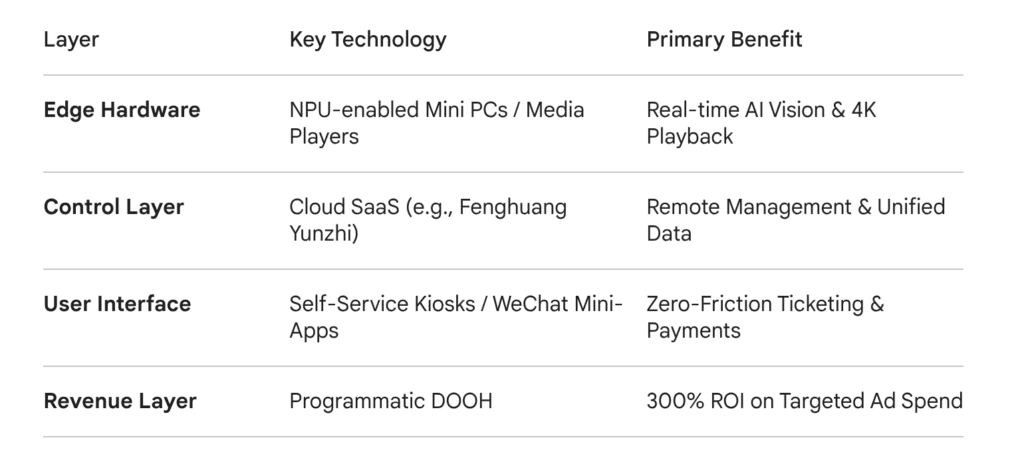
Stack tech
Unlike traditional cinemas that rely primarily on ticket sales, China’s smart cinemas generate value through:
AI turns cinema spaces into media assets, not just entertainment venues.
China offers a clear blueprint:
Self-service + AI + digital payments + SaaS integration = scalable smart cinema
However, replication will depend on:
China’s cinema industry is no longer just digitizing—it is redefining the role of physical entertainment spaces.
Through the integration of:
Cinemas are evolving into:
Intelligent, automated, revenue-optimized environments
The key takeaway for B2B stakeholders is clear:
The future of cinema is not just about content—it is about infrastructure.
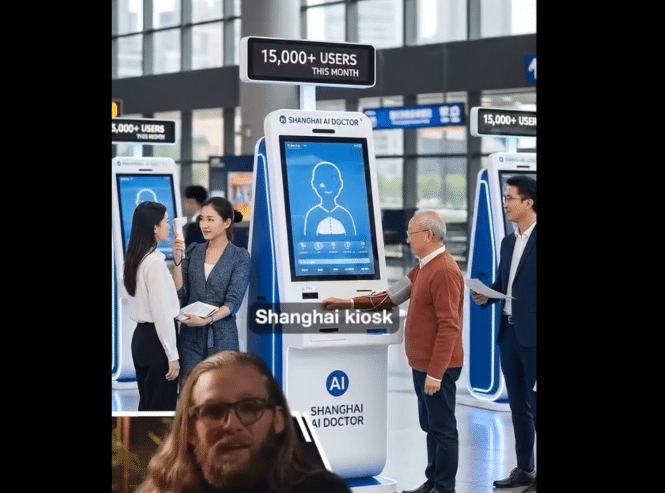
The healthcare shanghai kiosk for the public with AI, deployed, everywhere. China just put doctors inside vending machines, and they diagnose you in 4 minutes with 95% accuracy.
✅ 2,200 AI health kiosks deployed nationwide
✅ Trained on 300 million medical consultations
✅ 70% faster, 30% cheaper, human doctor still verifies
This isn’t a pilot. It’s fully operational. 15,000 people use the Shanghai metro kiosks every single month. While the world debates AI in healthcare, China already built it.
Will AI doctors come to your country? Instagram Link – https://lnkd.in/gS8ASaBR
China has rolled out a network of AI “doctor” kiosks nationwide, with Shanghai as one of the main deployment hubs, especially in the metro system and other high‑traffic public areas.
It is a walk‑in booth that looks like a small clinic or vending machine, providing 24/7 primary‑care style service in malls, stations, and community areas.
Users register, describe symptoms by voice or touch screen, and the kiosk’s sensors capture vitals such as blood pressure, heart rate, temperature, and sometimes basic ECG.
The AI engine compares symptoms and vitals against a dataset reported at over 300 million prior medical consultations covering nearly 2,000 diseases to generate a preliminary diagnosis and treatment suggestion.
A licensed remote physician then reviews each case before any prescription or strong recommendation is finalized, so the kiosk functions as “AI‑first triage plus human sign‑off,” not a fully autonomous doctor.
Reported figures from promoters claim around 95% diagnostic accuracy for the targeted set of common conditions, with roughly 70% reduction in waiting times and about 30% lower cost versus conventional visits for similar minor issues.
For Shanghai specifically, about 250 kiosks in the metro system alone are said to serve more than 15,000 people per month, turning what used to require a clinic visit into a 4‑minute interaction.
These kiosks sit under China’s broader “Healthy China 2030” and healthcare‑digitization push, alongside self‑service registration/payment terminals and telemedicine stations in community clinics.
Their stated goals are to offload minor illnesses and basic triage from overcrowded public hospitals, extend access in under‑served areas, and standardize basic primary‑care workflows with AI support.
Most units in Shanghai use a fairly standard medical‑kiosk stack: commodity x86/ARM (or domestic Phytium) box PC at the core, Windows/Linux‑class OS (often localized like Kylin), a sensor “chair” or pod for vitals, plus a cloud‑connected AI and telemedicine layer on top.
Compute core: Industrial box PC (e.g., JHCTECH CNTI‑D2K1) with Phytium D2000 8‑core CPU or similar x86/ARM, fanless, designed for 24/7 operation, with multiple USB 3.0, USB 2.0, and RS‑232 ports and PCIe for camera/AI or extra I/O.
Vitals module: Integrated medical‑grade peripherals for blood pressure, heart rate, SpO₂, temperature, and sometimes weight/BMI; some deployments add simple ECG or glucose as options.
Identity and UX: 21–32″ touch display, ID/health‑card reader, QR scanner, receipt printer, cameras for facial recognition and video consults, mic/speakers or handset.
Optional dispensing: In “doctor‑in‑vending‑machine” variants, a refrigerated/locked cabinet with controlled drawers that dispense common OTC or basic prescription meds after remote doctor approval.
Connectivity and security: Ethernet plus 4G/5G modem, hardware watchdog, secure boot; boxes are designed to run hospital‑hours workloads in noisy, hot public environments.
OS layer: Localized Linux (e.g., Kylin V10) or Windows IoT‑class OS, chosen to meet Chinese healthcare data‑security and “indigenous tech” requirements.
Edge apps: Kiosk middleware for device I/O (sensors, card readers, printer), session management, UI, and offline queueing if the cloud link drops.
AI engine: Cloud‑side medical models trained on over 300 million consultations and roughly 2,000 diseases; they fuse symptom input (touch/voice) with vitals to produce structured triage, differential diagnosis, and recommended orders.
Telemedicine services: Integrated video consult platform that routes cases to licensed doctors, presents the AI summary, and lets the doctor approve, modify, or reject prescriptions or referrals.
Integration: APIs into regional electronic health records and insurance platforms so visits can be logged, billed, and attached to the patient’s national ID/health ID.
Data handling: Encrypted transmission of vitals, images, and consultation records to central data centers; logs kept to support auditability and post‑hoc QA of AI decisions.
Local‑first control: Hospitals or city health bureaus typically manage device fleets centrally (remote monitoring, software updates, content/policy pushes) using standard kiosk‑management tooling adapted for medical workloads.
Compliance focus: Vendors emphasize “fully localized” hardware/OS stacks and adherence to Chinese medical‑data standards to align with national self‑reliance and cybersecurity rules.
Shanghai does not run a single, branded EHR like Epic or Cerner; instead it uses a city‑wide health information exchange platform that links many hospital EMR systems into a shared regional record.
Shanghai operates a municipal Health Information Exchange (HIE) that aggregates data from all tertiary hospitals and many district hospitals and community health centers into a unified longitudinal record for residents.
By 2016 this HIE covered 38 top‑tier hospitals, 6 district hospitals, and 40 community health centers and held records on roughly 39 million patients, including meds, imaging, encounters, and notes.
Individual hospitals in Shanghai typically run their own EMR systems from domestic vendors (for example, products like the Lixiang Electronic Medical Record System or similar local platforms), which then feed standardized data into the city HIE.
National specifications from China’s National Health Commission define how hospital EMRs must structure and exchange data, so Shanghai’s “primary” record in practice is the regional cloud EHR built from these EMR feeds rather than one commercial EHR product.
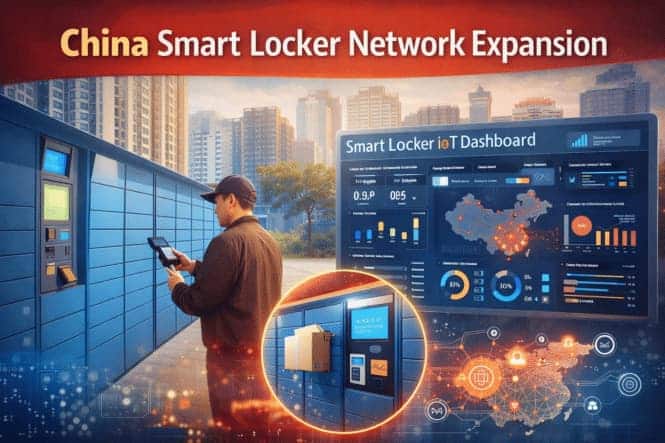
China’s rapid e-commerce growth has created a new logistics challenge: the “last meter” of delivery—the final step between the courier and the customer.
In dense cities filled with high-rise apartments, gated residential compounds, and large office complexes, traditional door-to-door delivery can be inefficient and expensive.
Smart lockers have emerged as a practical solution.
Across China, automated parcel lockers now operate as 24/7 self-service delivery infrastructure, allowing consumers to collect packages, groceries, meals, and even pharmaceuticals at convenient locations.
Key Takeaway: Smart lockers combine modular hardware, IoT monitoring, and digital access systems to transform the final stage of urban logistics.
Smart Tip — Careful with costs. For example, when exporting to regions with lower income expectations, such as Africa or Southeast Asia, the cost for a complete setup (master locker + slave locker) can be around USD 1,800. In contrast, in markets such as the United States or Europe, the typical price range is closer to USD 3,500.The most expensive project I have handled was around USD 4,300, where the locker was equipped with a printing machine and a POS terminal. However, this type of configuration is relatively rare, as most clients prefer to keep costs low in order to deploy lockers across as many locations as possible.
China is the world’s largest e-commerce market. Annual parcel volume exceeded 130 billion shipments in 2025, according to industry estimates from the China E-Commerce Logistics Alliance.
As online retail continues to expand, courier companies face several operational challenges:
These challenges have accelerated the deployment of centralized delivery infrastructure such as smart lockers located in residential communities, office parks, and retail centers.
Several companies have built large nationwide locker networks.
The largest is Hive Box, which operates more than one million smart locker units across Chinese cities.
Other technology suppliers include:
Industry analysts from Cognitive Market Research estimate that smart lockers currently handle 15–20% of urban e-commerce deliveries in major Chinese cities, with adoption projected to reach 25% in high-density areas within the next few years.
Smart lockers operate as self-service kiosks integrated with logistics software and cloud platforms.
The technology stack typically includes several hardware and software components.
Smart lockers use modular compartment systems designed to accommodate different types of deliveries.
Configurations often include:
This flexibility reduces failed delivery attempts by 15–25% in many residential complexes.
Most smart locker systems incorporate IoT sensors and cloud connectivity.
These features allow operators to monitor:
Real-time data enables courier companies to optimize delivery routes, which can reduce logistics labor costs by 10–20%.
As locker usage expands beyond parcels, temperature-controlled storage has become increasingly important.
Refrigerated locker modules can maintain stable temperatures suitable for:
According to industry data, temperature-controlled lockers reduce spoilage losses by 5–10% compared with traditional unattended delivery.
Smart locker systems typically integrate with mobile apps, enabling customers to unlock compartments via QR codes or digital authentication.
Touchless retrieval reduces wait times and improves customer convenience, contributing to adoption rates growing 20–30% annually in many residential communities.
While parcel delivery remains the primary use case, China’s smart locker networks are expanding into several new service areas.
These include:
Multi-purpose lockers that handle both parcels and food deliveries show 15–20% higher utilization rates than parcel-only systems.
This trend reflects the increasing demand for integrated urban delivery infrastructure.
China’s smart locker ecosystem offers important lessons for the global self-service technology industry.
Smart lockers share many architectural similarities with self-service kiosks, including:
As a result, many kiosk hardware suppliers are also entering the smart locker market.
China’s dominance in several hardware components—including display panels, embedded PCs, and IoT devices—gives its manufacturers a strong position in this growing sector.
The smart locker model is now expanding internationally, with deployments appearing in:
As cities worldwide face similar last-mile delivery challenges, automated pickup infrastructure may become a standard component of urban logistics systems.
China’s smart locker networks demonstrate how hardware innovation, IoT connectivity, and logistics integration can solve one of the most persistent challenges in modern e-commerce: the last meter of delivery.
By consolidating deliveries at centralized pickup points, lockers reduce operational costs, improve courier efficiency, and enhance convenience for consumers.
As parcel volumes continue to grow globally, China’s smart locker ecosystem may serve as a blueprint for cities seeking to modernize their urban logistics infrastructure
Estimated share of global deployments: Asia-Pacific (led by China) is one of the fastest-growing regions, driven by e-commerce scale
Urban penetration: Tier 1–2 cities approaching “default infrastructure” status in residential compounds
Locker density (top cities): Global benchmark ~450 lockers per 100K people (China metros are at/above this in dense zones)
China is part of the 1.5B+ parcels annually processed via lockers globally
High-frequency usage driven by:
JD / Alibaba logistics ecosystems
Same-day / next-hour delivery expectations
E-commerce dominance: China leads global parcel volume (>100B parcels annually overall ecosystem)
Labor economics: lockers reduce last-mile labor dependency
Residential integration: lockers embedded in:
apartment complexes
transit hubs
campus-style developments
Locker usage in China is often:
Default delivery option, not alternative
Heavily integrated with QR/mobile-first workflows
Higher penetration of:
AI-enabled access / facial recognition
Mobile super-app integration (WeChat, Alipay)
Strong domestic OEM ecosystem (e.g., Zhilai Tech, China Post)
Figure 400,000 in China.
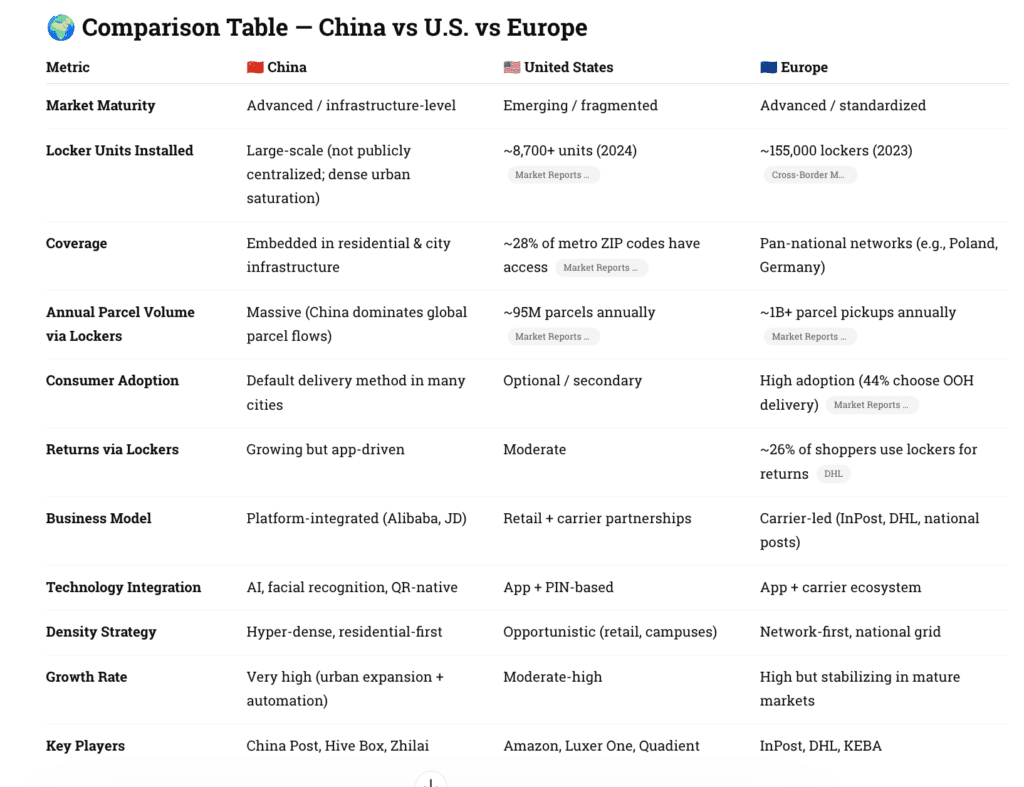
Smart lockers China
Smart lockers are built into daily life
Comparable to:
elevators
mailrooms
Strong linkage to super-app ecosystems
Highly structured carrier-driven networks
Example:
Poland alone → 30,000+ lockers
Strong consumer adoption for both delivery and returns
Adoption exists but:
not standardized
not default behavior
Strong upside in:
multifamily housing
BOPIS / retail integration
End of content
NEWS HIGHLIGHTS:
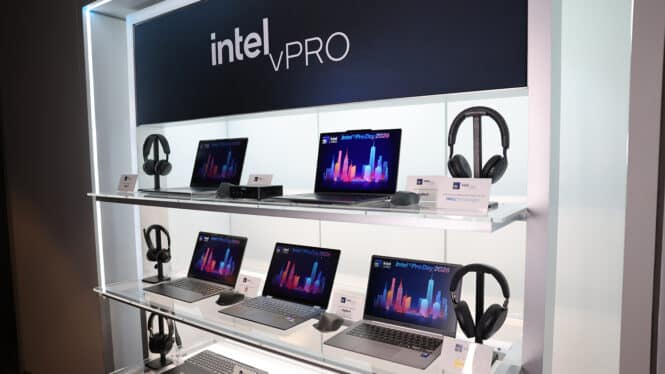
NEW YORK, March 25, 2026 – Intel today unveiled its most advanced commercial client portfolio, purpose-built for every type of professional and powering more than 125 designs. The new Intel Core Ultra Series 3 with Intel vPro delivers an optimized PC experience for end users with power-efficient performance, industry-leading security and easy device management for IT teams. Intel also unveiled its high-end Intel® Arc™ Pro B70 & B65 discrete graphics cards, alongside retail availability for its Intel® Xeon™ 600 processors for workstation, both of which are designed to deliver high compute and scalability for professionals across every industry.
At the center is Intel Core Ultra Series 3, the first commercial PC platform built on Intel 18A, bringing next-generation performance efficiency and integrated AI acceleration to businesses worldwide. Combined with the latest Intel vPro® platform enhancements, Intel is redefining what organizations can expect from managed PCs – from seamless deployment to proactive security and intelligent fleet operations.
“From commercial laptops to high-performance workstations, this is the most expansive and capable commercial portfolio Intel has ever delivered. We’re enabling IT and business leaders with the performance, power efficiency, security, manageability and AI capability they need to power the next era of work.”
– David Feng, Vice President of Client Computing Group and GM of PC Segments
Event Press Kit: Intel at Pro Day 2026
More
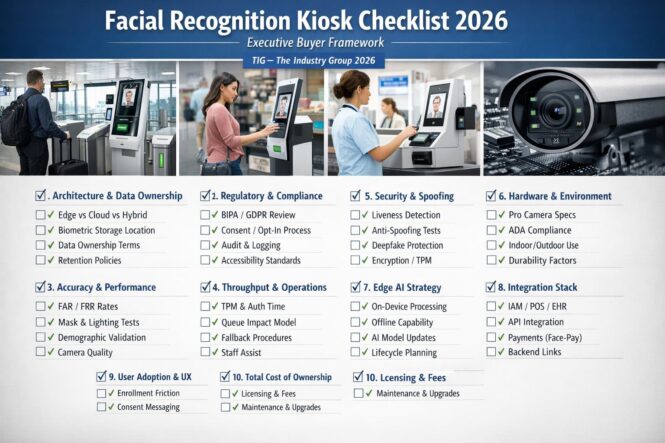
5A.Trusted Platform Security.
What changes vs your checklist:
What changes:
Add to checklist:
More balanced:
Add:
What changes:
Add to checklist:
More
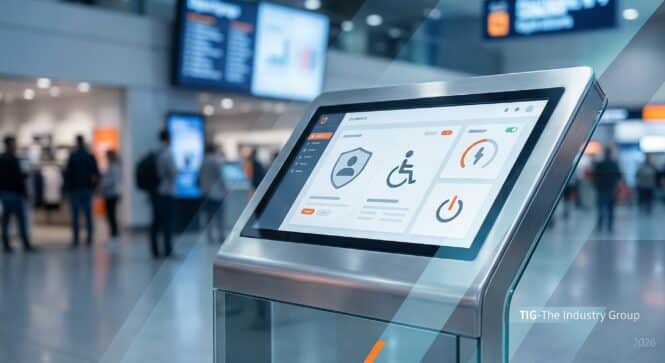
identity integration (Keycloak), accessibility hardware, power/device control, and a more modern, stable technical base.
Identity & security
Keycloak is now supported as an identity provider for both cloud and on‑prem deployments, extending SSO and user management integration options (setup requires consultation).
Accessibility & input hardware
Adds support for the ANKER EAA‑Pad as an accessibility device, broadening supported accessible usage scenarios on kiosks. See EAA Checklist for Accessible Kiosk Design
Power and device management
Supports Nexmosphere NEO for power management, enabling more advanced use cases where display power supply and device control are relevant (e.g., turning peripherals on/off).
Editor fixes
Fixes issues in the project editor when handling .webp and .gif images, improving reliability for asset-heavy layouts.
Runtime stack refresh
Updates the client platform to Electron 40.5.0 with Chromium 144.0.7559.177, giving a more current browser engine for stability, security, and compatibility in continuous operation. [144 is a January 2026 stable and extended‑stable branch (now also LTC/LTS in some ChromeOS channels).
General stability
Includes additional unspecified bug fixes and optimizations across the platform.
Better fit into enterprise IAM stacks (via Keycloak) in both cloud and on‑prem kiosk/signage environments.
Stronger accessibility story at the hardware level (EAA‑Pad) on top of the earlier accessibility features introduced in 1.7–1.8.
Improved options for interactive retail or DOOH scenarios where power control and sensor-driven experiences via Nexmosphere gear matter.
Reduced risk from an aging embedded Chromium and fewer editor hiccups with modern image formats.
Keycloak is an open‑source identity and access management (IAM) platform used to handle authentication, single sign‑on, and authorization for applications and APIs.
Core idea
Runs as a central identity provider (IdP) that apps trust for login, logout, and token issuance instead of each app managing its own accounts.
What it provides
Single sign‑on and single logout across multiple web, mobile, and backend apps using OpenID Connect and SAML.
User management, roles, and groups, including integration with LDAP/Active Directory or external IdPs (Google, Azure AD, etc.).
Identity brokering and federation so you can plug multiple identity sources into one consistent login experience.
In kiosk/digital signage terms, it’s the central SSO service your players, CMS, and admin portals can delegate login to, instead of each system rolling its own auth.
More
It’s significant because it treats kiosk literacy for seniors as a mainstream “home appliance” feature, not a niche training program, and it fits into a broader accessibility and aging‑society strategy for LG and for Korea.
It acknowledges kiosks as basic infrastructure. When only 17.9% of Koreans 65+ say they can use kiosks for ordering/registration, they are effectively excluded from a big chunk of everyday commerce. Turning kiosk training into a TV app reframes it as essential life‑skills support, like remote health or medication reminders.
It extends LG’s senior platform. Easy TV was already a senior‑focused product with simpler UI, larger fonts, and services like LG Buddy for remote family support and reminders. Adding kiosk practice and brain‑health games deepens that ecosystem rather than being a one‑off feature.
It directly addresses the “fear and friction” barrier. Seniors can rehearse kiosk flows (burger QSR, café, food court) end‑to‑end—from item selection through payment—without time pressure, queues, or social embarrassment. That’s the biggest psychological blocker in real stores.
It builds a training channel retailers don’t control. Instead of retailers installing special training kiosks, training moves upstream into the home; in theory, chains could later co‑design TV scenarios that match their own UIs. This opens a new B2B content/partnership angle for LG.
It differentiates LG in an aging‑market race. South Korea, Japan, the US, and EU are all dealing with rapidly aging populations; LG has already said Easy TV is intended for export to those markets. Kiosk training plus brain games and Buddy give LG a clearer senior‑lifestyle value proposition than “just a simpler TV.”
It complements LG’s own kiosk hardware strategy. LG is promoting more accessible kiosk designs (larger touch targets, better UX, etc.). Teaching seniors kiosk mental models at home makes it more likely that LG‑style kiosk UX conventions become the default “learned” pattern in the population.
It aligns with government concern over the digital divide. Korea has already been running kiosk‑training programs through senior centers because older adults struggle with digital self‑service in a “contact‑free” culture. By quantifying the gap (only 17.9% confident users) and productizing a response in a mass‑market TV, LG positions itself as a private‑sector partner in digital inclusion.
It normalizes “practice mode” as part of UX. If this model spreads, you could see kiosk “simulator” apps on TVs, tablets, and phones become an expected accessibility feature, similar to screen readers or high‑contrast modes today.
From our kiosk‑industry lens, the interesting question is whether large QSR/retail brands will start co‑developing LG‑style at‑home training experiences that mirror their own flows—do you see clients being willing to invest in that kind of pre‑store training content?
From Chosun March 2026
A service has been launched allowing seniors to practice using kiosks (unmanned payment devices) on TV beforehand.
LG Electronics announced on the 29th that it will introduce the ‘CareU’ service, which enables kiosk ordering practice on the ‘LG Easy TV.’ Currently, the service is only available on the ‘LG Easy TV,’ a senior-friendly TV released last year by LG Electronics, reflecting feedback from senior customers.
The kiosk practice service was developed to assist senior customers struggling with complex screen layouts and unfamiliar payment procedures. According to the Ministry of Health and Welfare’s ‘2023 Senior Citizens Survey,’ only 17.9% of those aged 65 years old and older responded that they could use kiosks for ordering and registration.
The ‘CareU’ service is designed to help users easily learn kiosk usage in various situations by realistically implementing three everyday kiosk environments: hamburger restaurants, cafes, and food courts. For example, users can experience the entire process—from selecting food to payment—by placing an order via a kiosk at a hamburger restaurant, as demonstrated on the screen. LG Electronics stated, “We planned this service to help senior customers practice using kiosks comfortably at home, thereby boosting their confidence in using digital devices and making kiosk usage easier.”
LG Electronics has also incorporated brain health games for senior customers into not only the ‘LG Easy TV’ but also the ‘StandbyMe 2’ and ‘StandbyMe Go’ devices. The company plans to sequentially expand the application of the ‘LG Buddy’ and brain health games to other LG smart TVs.
More