
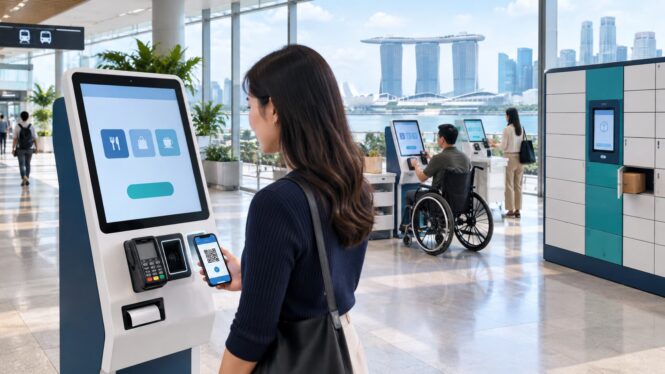
Singapore is best viewed as a technology validation market rather than a miniature version of Southeast Asia.
A kiosk that works in Singapore has passed a useful test. It has not earned an ASEAN passport.
That distinction should guide the deployment strategy. A pilot can establish whether the hardware, payments, software integrations, accessibility features, and support procedures work together. It does not establish that the same configuration will work unchanged in Malaysia, Thailand, Indonesia, or Vietnam.
The objective is validation: prove the transaction, measure the exceptions, and establish what it costs to keep the service running.
That also means looking beyond the cabinet. The customer’s phone may participate in the transaction. An accessible interface may require more than a touchscreen. Remote management may determine whether a minor fault becomes an expensive service call.
The screen is the visible part. The operating model is what buyers should evaluate.
Singapore Kiosk Deployment: Three Real-World Examples
Changi Airport: The Transaction Does Not End at the Kiosk
Changi Airport’s Fast and Seamless Travel, or FAST, programme connects self-service check-in with other passenger-processing stages. Eligible passengers on participating airlines can obtain boarding passes and baggage tags at kiosks before proceeding to automated bag drop. Availability depends on airline participation and passenger eligibility.
The lesson is not that an airport installed touchscreens. It is that the kiosk is one step in a connected workflow.
For a pilot, I would ask:
-
Does information pass correctly to the next system?
-
Does the printed output work at the next stage?
-
Can the customer recover from an error?
-
Can staff identify the problem without restarting the entire process?
Printing a boarding pass is a device outcome. Getting the passenger through the next step is a service outcome. Buyers should distinguish the two.
FairPrice: Self-Service Does Not Mean Staff-Free
FairPrice Finest’s Sengkang Grand Mall store opened in March 2023 with 12 self-checkout counters accepting cash and cashless payments, supported by service ambassadors. FairPrice also described four Scan & Go counters for app-based shopping.
That is a more useful operating model than a vague claim of “fully automated retail.” It combines different transaction paths with customer assistance.
FairPrice’s Scan & Go instructions also identify payment exceptions: the mobile service accepts digital payments, while customers using specified vouchers are directed to self-checkout or a cashier.
Those exceptions belong in the business case.
For any retail pilot, record how often employees intervene, why assistance was necessary, and how long resolution took. Otherwise, a fast-looking checkout process may conceal support work that never appears in the demonstration.
Pick Network: The Cabinet Is Only Part of the Service
Pick Network describes an island-wide network of approximately 1,000 parcel locker stations offering around-the-clock collection. Its network connects marketplaces, merchants, and logistics service providers.
A locker deployment therefore involves more than functioning doors. The compartment, parcel record, customer credential, and collection event must remain consistent.
My acceptance questions would include:
-
Does the correct credential open the correct compartment?
-
What happens when the compartment fails to open?
-
Can support distinguish a communications fault from a mechanical fault?
-
Who owns the customer problem when several companies participate?
Installing equipment and operating an unattended service are different responsibilities. Procurement should identify both.
Accessibility: Build It Into the Platform
A public kiosk is not simply a website mounted in a cabinet.
Many terminals have “closed functionality”: users cannot install or connect the assistive technology they normally use. W3C’s WCAG2ICT guidance addresses this distinction and explains why a system may need built-in accessibility features rather than assuming an external screen reader will provide access.
For buyers, that means evaluating the complete transaction:
-
Can a seated customer reach the controls, payment reader, scanner, and output?
-
Can a customer complete the task without relying entirely on vision?
-
Is there an alternative when touch-only input creates a barrier?
-
Are important audible instructions also available visually?
-
Can the customer correct a mistake without losing progress?
-
Does accessible operation preserve privacy?
These concerns align with the physical-access, speech-output, control, and privacy issues addressed in self-service-machine accessibility guidance and standards.
An accessible welcome screen is not enough. The test is whether the customer can complete the task—including payment, error recovery, and collection of the physical output.
Use Global References Without Confusing Their Roles
For suppliers designing a reusable platform, several references are relevant:
| Reference | Practical role |
|---|---|
| WCAG 2.2 and WCAG2ICT | Digital accessibility criteria and guidance for applying them to non-web software and closed-functionality systems. WCAG2ICT is informative guidance, not a standalone kiosk certification. |
| EN 301 549 | Technical accessibility requirements for ICT, including hardware and software—not merely web pages. |
| European Accessibility Act | Legal requirements for specified products and services, including payment terminals and certain ticketing, check-in, and information terminals. Requirements began applying in June 2025, subject to scope and transitional provisions. +1 |
| U.S. accessibility requirements | Existing requirements address particular equipment and deployment contexts. The Access Board has separately pursued broader self-service-machine rulemaking; buyers should not assume one universal commercial-kiosk specification. |
These references do not replace Singapore requirements, nor does meeting one automatically establish compliance elsewhere.
The procurement deliverable should be a requirements matrix: what applies, which component satisfies it, and how the installed system will be tested.
Mobile-to-Kiosk Interaction: Extend Access Without Creating Barriers
FairPrice provides a concrete example of mobile and fixed self-service working together.
Customers can access Scan & Go through the FairPrice Group app and identify their store using GPS or a store QR code. FairPrice’s help centre also describes scanning the receipt QR code at a kiosk when exiting. The phone and terminal participate in the same shopping journey.
That is different from simply accepting a mobile wallet at the payment reader.
For a Singapore pilot, I would evaluate four possible interaction patterns:
| Pattern | What to validate |
|---|---|
| Prepare on mobile, finish at kiosk | Retrieve the correct order or application without unnecessary re-entry |
| Start at kiosk, continue on mobile | Preserve progress and securely associate the phone with the right session |
| Use an accessible mobile companion | Complete the task using the phone’s accessibility features |
| Present a mobile credential | Read tickets, bookings, or collection codes under realistic conditions |
These are proposed design patterns, not claims that every cited deployment supports them.
W3C’s mobile accessibility guidance provides a framework for applying WCAG 2.2 to native, web, and hybrid mobile applications. A companion interface needs its own accessibility testing; it does not inherit accessibility from the kiosk.
Mobile Should Extend Access, Not Become the Admission Ticket
“Scan this QR code” is a handoff instruction, not an accessibility strategy.
Our procurement conditions would include:
-
An alternative when the customer cannot locate or scan the code.
-
A usable path for customers without a compatible smartphone or data connection.
-
Testing with screen readers, enlarged text, and accessible authentication.
-
No unnecessary app installation for a simple, occasional transaction.
-
A physical design that remains usable after the phone interaction finishes.
A mobile interface does not lower an unreachable payment reader or make a high locker compartment accessible.
Singapore’s inclusion programmes also caution against assuming universal smartphone readiness.IMDA offers subsidised smartphones and mobile plans to eligible lower-income seniors alongside digital-skills support.
The phone should provide another way through—not another barrier.
Privacy and Security Follow the Transaction
Singapore’s Personal Data Protection Act governs the collection, use, disclosure, and care of personal data. A deployment assessment should therefore begin with the information being handled and the parties handling it.
Ask suppliers to document:
-
What personal information is collected and why.
-
Where it is processed and stored.
-
Which vendors and support personnel can access it.
-
What appears in diagnostic logs.
-
How long records are retained.
-
How sessions are cleared between customers.
A phone-to-kiosk handoff adds another boundary to test. I would require explicit checks for expired pairing codes, session hijacking, duplicate payment attempts, interrupted connections, and cancellation across both interfaces.
Remote support deserves similar scrutiny: who can access the fleet, what actions they can perform, and how those actions are authorized and logged.
Keep legal obligations, payment-provider requirements, venue conditions, and recommended practices distinct. A general claim of “Singapore compliance” is not a substitute for identifying the requirements applicable to the installation.
Standards and Approvals: What Buyers Should Verify
A successful Singapore deployment does not establish that a kiosk is approved for another market—or that every part of the installation has been assessed together.
The procurement question is not simply, “Is it compliant?” It is: compliant with which requirements, for which model and configuration, running which software, and installed where?
The Changi, FairPrice, and Pick Network examples in this article illustrate operating models. The public sources reviewed do not establish their complete safety-certification records, EAA conformity, or installed CUSS versions. Buyers should request that evidence separately rather than infer it from the deployment’s visibility or scale.
Electrical Safety: Check the Complete System
“UL-rated” is too vague for a purchase specification. Ask for the certification body, applicable standard and edition, certificate or listing number, and exact models covered.
UL/IEC 62368-1 is a relevant safety-standard family for equipment within the audio/video and information-technology scope. However, the correct evaluation depends on the product and its intended use; it should not be selected solely because the kiosk contains a computer.ul+1
A certified display, power supply, or embedded computer does not by itself establish certification of the assembled terminal. Component evaluation and end-product evaluation are different matters. Buyers should confirm that the enclosure, peripherals, power configuration, and subsequent modifications remain within the evaluated configuration.shopulstandards+1
Accessibility: Separate Technical Testing From Legal Conformity
For European expansion, determine whether the product or associated service falls within the European Accessibility Act’s scope. The EAA includes payment terminals and specified ticketing, check-in, and interactive information terminals. Requirements began applying on June 28, 2025, subject to applicable exceptions and transitional provisions. It does not automatically cover every kiosk application.
EN 301 549 provides technical accessibility requirements covering ICT hardware and software. WCAG2ICT explains how WCAG principles apply to non-web software and closed-functionality systems, but it is informative guidance—not a standalone kiosk certification.
For procurement, require an accessibility assessment of the complete installed journey: approach, controls, payment, instructions, error recovery, privacy, and collection of any physical output. A statement that the interface “follows WCAG” does not establish that the entire installation meets applicable legal requirements.
Airport Systems: Specify the CUSS Version
CUSS—Common Use Self Service—is IATA’s framework for shared airport self-service platforms. It is relevant to common-use airline systems, not a general certification for retail kiosks or parcel lockers.
IATA’s common-use standards page identifies CUSS technical specification version 2.3.2. That does not establish which version an individual airport operates. Similarly, Changi’s FAST branding describes a passenger-service programme, not a verified CUSS version.
Airport buyers should request the installed platform version, airline-application compatibility and certification status, peripheral support, and migration plan. IATA’s migration material distinguishes CUSS 2 platforms from transitional support for CUSS 1.5 applications—an important reminder that platform and application versions are not interchangeable.
CUSS compatibility also does not replace electrical-safety, accessibility, payment-security, or local regulatory assessments. Those address different requirements.
Singapore Requirements: Assess the Actual Configuration
Singapore does not provide one universal “kiosk approval.”
The SAFETY Mark regime applies to 33 specified categories of controlled household electrical, electronic, and gas goods and accessories. Suppliers should check whether the product or supplied accessories fall within those definitions rather than assume that every kiosk requires—or is covered by—the mark.consumerproductsafety.gov+1
Connected equipment also needs assessment against applicable IMDA telecommunications requirements. Registration routes depend on the equipment; specified short-range devices, including wireless LAN and Bluetooth equipment, fall within IMDA’s registration framework. Confirm the covered models and final radio configuration rather than relying solely on a module supplier’s claim.
For card payments, verify the exact payment-device model and its PCI PTS approval status against PCI SSC’s approved-device listing. Device approval should be distinguished from applicable PCI DSS obligations for the wider payment environment and the acquirer’s acceptance requirements.
Put the Evidence in the Procurement File
Before accepting a deployment, require a standards-and-approvals register containing:
-
Applicable requirements for the destination and use case.
-
Covered hardware models, peripherals, and software versions.
-
Certificates, listings, test reports, and conformity documentation.
-
Accessibility findings and unresolved limitations.
-
Payment-device approval details and acquirer acceptance.
-
Radio-equipment registration or documented exemption.
-
Responsibility for reassessment when components or configurations change.
The buyer’s objective is traceability, not a collection of logos. A safety-approved component does not approve the cabinet. An approved payment terminal does not approve the network. A common-use airport platform does not establish accessibility.
Build the evidence file alongside the pilot. It should be part of the expansion decision—not paperwork requested after the next installation is already ordered.
What a Singapore Pilot Should Measure
A demonstration proves the system can work. A pilot should establish how reliably it works, who cannot use it, and what happens when it fails.
| Test area | Required evidence |
|---|---|
| Customer completion | Completed, abandoned, and failed sessions using predefined categories |
| Payment integrity | Timeouts, reversals, duplicate charges, and reconciliation exceptions |
| Integration | Missing orders, inconsistent records, and recovery after interruption |
| Hardware | Faults by component and time to restore service |
| Accessibility | Independent task completion across the complete journey |
| Mobile interaction | Pairing success, interrupted handoffs, credential readability, and no-phone alternatives |
| Support | Staff interventions, remote resolutions, and site visits |
| Economics | Installation, integration, connectivity, consumables, support, and downtime costs |
Set acceptance thresholds before the pilot begins. Otherwise, success becomes whatever the installed system happened to achieve.
Test failures deliberately. Interrupt connectivity. Exhaust the printer paper. Restart the application mid-session. Confirm what the customer sees, what support sees, and whether the transaction record remains correct.
What Transfers Across ASEAN?
The objective is a reusable platform—not an identical installation everywhere.
We would carry forward proven capabilities such as transaction-state handling, device diagnostics, software deployment procedures, and accessibility architecture.
We would separately revalidate local payment arrangements, languages, customer assistance needs, connectivity, field-service coverage, regulatory requirements, and operating costs.
Even reusable capabilities need regression testing when hardware, software, or payment components change.
Before approving expansion, require a target-market acceptance plan. State what stays the same, what changes, who owns each integration, and who proves that the resulting service works.
How Large Is the Interactive Kiosk Market?
Market forecasts help establish scale, but kiosk categories need careful handling.
Grand View Research estimates the following revenues for its broad interactive-kiosk category:
| Geography | 2025 estimated revenue | 2026 estimated revenue | 2033 forecast |
|---|---|---|---|
| Global | US$37.2 billion | US$39.9 billion | US$65.3 billion |
| Asia-Pacific | US$7.86 billion | US$8.60 billion | US$16.81 billion |
These are research-provider estimates and forecasts, not audited industry sales totals.
More importantly, the study includes ATMs, retail self-checkout, self-service kiosks, and vending kiosks, along with hardware, software, and services. ATMs alone accounted for 50% of its estimated global revenue in 2025. Quoting the entire figure as the addressable market for restaurant ordering terminals or hotel check-in kiosks would be misleading.
Asia-Pacific is also not ASEAN. Its regional total includes large markets outside Southeast Asia, including China, Japan, and India.
For the applications discussed in this article, those figures provide market context—not a Singapore market valuation or a precise opportunity estimate. A useful supplier forecast needs a narrower definition: target applications, eligible locations, terminals per location, replacement cycles, and recurring software and service revenue.
My view: count the installations you can realistically serve before quoting the billions you theoretically address.
Craig Allen Keefner Insight
The next step in self-service is not necessarily a bigger touchscreen or another AI feature. It is a better division of work between the public terminal, the customer’s phone, the employee, and the service platform.
Let each perform the task it handles best. Make the handoffs accessible, secure, and recoverable.
Singapore’s value is the evidence a disciplined deployment can produce. Use that evidence to build an adaptable service—not a regional sales claim.
Reference Sources
-
- Grand View Research — Global Interactive Kiosk Market, 2026–2033
- Grand View Research — Asia-Pacific Interactive Kiosk Market Outlook
- Grand View Research — We give Grand View Research 6/10 as a secondary source for market context—and about 4/10 as the sole basis for valuing the specific smart-kiosk opportunity in your article.To their credit they publish both a general methodology and a report-specific methodology section for the interactive-kiosk study.
- Changi Airport — FAST Self-Service Check-In and Automated Bag Drop
- Cathay Pacific — Singapore Changi Airport Check-In Information
- FairPrice Group — Digital-First FairPrice Finest at Sengkang Grand Mall
- FairPrice — Scan & Go Shopping and Payment Options
- FairPrice Help Centre — How to Begin Using Scan & Go
- FairPrice Help Centre — Scan & Go, Exit Procedures and Verification
- Pick Network — Singapore’s Islandwide Parcel Locker Network
- Pick Network — About the Parcel Locker Service and Logistics Network
- W3C — Guidance on Applying WCAG 2 to Non-Web ICT: WCAG2ICT
- W3C Web Accessibility Initiative — WCAG2ICT Overview
- W3C Working Group Wiki — WCAG2ICT Introduction and Closed Functionality
- W3C — Guidance on Applying WCAG 2.2 to Mobile Applications
- AccessibleEU — EN 301 549 Accessibility Requirements for ICT Products and Services
- ETSI — EN 301 549 V3.2.1 Technical Standard (PDF)
- European Commission — European Accessibility Act Overview
- European Commission — European Accessibility Act Application from June 2025
- European Disability Forum — Products and Services Covered by the European Accessibility Act
- U.S. Access Board — Self-Service Transaction Machines and Kiosk Accessibility
- IMDA Singapore — Digital Access and Inclusion Programmes
- IMDA Singapore — Mobile Access for Seniors
- IMDA Singapore — Seniors Go Digital
- Personal Data Protection Commission Singapore — PDPA Overview