
Where It Works, Where It Fails, and What Buyers Need to Measure
Why use machine vision instead of a $20 barcode scanner?
Because the barcode fails more often than the vendors admit. It fails on produce. It fails on damaged packaging, on multipacks, on the item the customer sets down at the wrong angle, on baskets too large for one person to scan in a reasonable amount of time. The future of self-checkout may not be vision replacing the barcode. It may be vision deciding when the barcode isn’t enough.
But getting there is harder than the demos suggest, and this is the part of the conversation that gets skipped at trade shows. A computer vision self-checkout system succeeds only when recognition, product presentation, customer behavior, payment, loss prevention, staff workflow, privacy, and support all work together. The question is not whether a model can recognize a bottle of tea. Any model can recognize a bottle of tea. The real question is whether a retailer can reliably identify every item in a changing basket, resolve exceptions quickly, protect margin, and keep the customer moving.
Before we go further, let’s draw a line that most coverage of this category blurs, because blurring it costs buyers money. There are two very different systems being sold under the same “AI checkout” label.
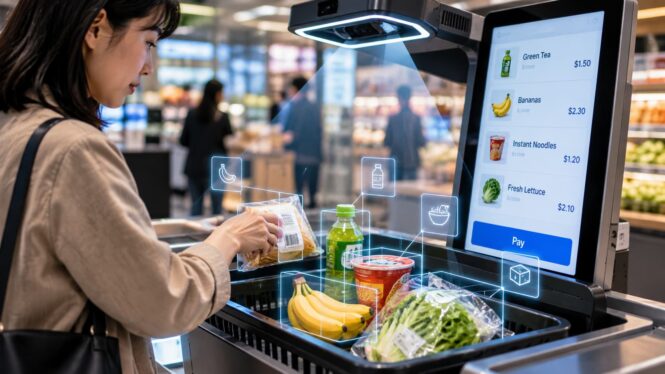
Vision-assisted checkout is what most Asian grocers and convenience operators are actually deploying. The shopper presents items at a kiosk, counter, basket station, or smart cart. Cameras identify or validate products, usually alongside barcode scanning, scales, RFID, or some combination of the three. Note that RFID is not merely a sidekick to vision — in some categories it is an alternative identification layer in its own right, and a cheaper one. More on that below. The customer is still doing the work of presenting the goods. The vision is there to catch what the barcode misses.
Autonomous or walk-out checkout is a different animal entirely. The system tracks product-taking and return behavior throughout a controlled retail environment, builds a virtual basket as the shopper moves, and settles payment when the customer exits. No scanning. No presenting. No traditional checkout event at all.
Treating a compact assisted-checkout terminal as operationally equivalent to a ceiling-camera, gate-controlled autonomous store is the single most common mistake buyers make in this category. The hardware, the site requirements, the integration burden, and the economics are not comparable. Keep that distinction in mind through everything that follows.
Where the Technology Fits — and Where It Doesn’t
Computer vision is not a religion. It is a tool, and like every tool in this industry it has a range of conditions where it earns its keep and a range where it doesn’t. Here’s the honest version:

Comparison
Note the last column of that table. Computer vision may still be useful in the difficult formats — produce, deep baskets, high-shrink categories — but not necessarily as the primary transaction-recognition mechanism. The honest question for any operator is which row of the table their store actually sits in, not which row they wish it sat in.
Three deployments from across Asia illustrate the range. Each makes a different point, and together they map the category better than any vendor deck.
Japan: CATCH&GO — Sensor Fusion, Not Just Cameras
Japan’s CATCH&GO is often described as an AI checkout deployment. That description undersells it, and the underselling matters.
CATCH&GO is an autonomous-store system that combines AI computer vision, deep learning, and multi-sensor fusion to recognize shopper actions and product interactions. NTT DATA presents it as much as an infrastructure and behavioral-data solution as a cashierless one — capturing items picked up and returned to shelves alongside the transaction itself.
The lesson for buyers is not “install more cameras.” It is this:
- Camera coverage must map to actual customer movements and product interactions — not just the aisles.
- A reliable virtual basket requires well-defined shelf and store layouts. Autonomous checkout is partly a store-design project.
- Sensor fusion reduces dependence on any single recognition signal. When the camera hesitates, the shelf sensor confirms.
And here is the trade-off nobody puts in the brochure: more infrastructure improves performance, but it raises deployment complexity, commissioning requirements, maintenance, and total cost of ownership. In Asia’s space-constrained, assortment-dense, labor-sensitive, cost-conscious retail environments, that trade-off is not a footnote. It is the decision.
India: BigBasket — The Hidden Constraint Is the SKU Lifecycle
BigBasket’s Fresho deployment is the more instructive example for most Asian grocers, precisely because it is not a fully autonomous store. It is vision-assisted checkout in a real grocery context — identifying FMCG products at the billing station alongside unpacked, packed, and loose fruit and vegetables. BigBasket reported the technology across more than 20 stores in three cities, with a cloud-based inference engine processing live terminal images and returning a SKU identification.
Here is the point most coverage misses:
Grocery recognition is not a model-accuracy challenge. It is a data-operations workload.
New SKUs arrive constantly. Packaging gets revised. Two products from the same brand look nearly identical until you read the fine print. Seasonal produce rotates through. Loose items have no barcode at all and no fixed appearance. The catalog never stops changing, and the model has to keep up with it — which means somebody has to photograph the new SKUs, label the training data, validate the results, and resolve the exceptions the model gets wrong.
BigBasket’s AWS case study makes this concrete: the work focused on improving FMCG product identification while cutting training time by roughly 50 percent and costs by 20 percent. Those are operational numbers, not accuracy numbers. And they point at the retailer’s real cost in this category: not the initial model or terminal, but ongoing SKU onboarding and model lifecycle management. Budget for that line item before you budget for cameras.
The Third Technology in the Room: RFID
Machine vision is not the only way to answer the question “when the barcode isn’t enough.” Item-level RFID has been answering it in apparel and general merchandise for a decade — without a camera.
Decathlon built its self-checkout on RFID years before computer vision was deployable at scale: drop the basket in the bin, every item reads at once, near-100% accuracy, no line of sight, no exceptions. Fast Retailing followed chainwide in Japan, where drop-your-items-in-the-bin checkout is now unremarkable in Uniqlo stores.
RFID wins where it wins for structural reasons. One read event replaces per-item recognition, and the exception problem that dominates the metrics section largely disappears. But the tag is also its ceiling. At roughly 3 to 8 cents per tag at volume, plus tagging labor, the economics work for a $30 shirt and collapse for a $1.50 pack of noodles. Liquids and metals degrade reads, which makes RFID a grocery problem before it is an apparel problem.
The useful way to frame the two: RFID’s constraint is unit economics per item; vision’s constraint is accuracy per transaction. Neither is universal, and both beat the barcode in different aisles.
And they are not rivals so much as fusion partners — the same sensor-fusion logic behind CATCH&GO, applied at the item level. The division of labor now emerging in the field: RFID handles the tagged, packaged, higher-margin categories; vision handles everything untagged — produce, loose goods, bakery, the long tail that will never justify a tag. In Asia, where tagging labor is relatively cheap but the tags themselves are priced globally, that division tilts differently than it does in Europe or the US. One more reason to fit the technology to the store, not the store to the technology.
Singapore: FairPrice — Vision as Staff Augmentation
FairPrice’s “Store of Tomorrow” program is not the cleanest example of computer-vision self-checkout, and that is exactly why it belongs here. It shows what video analytics looks like when it is deployed as store operations rather than labor elimination.
FairPrice describes its Vision AI as CCTV-based video analytics that alerts staff to events requiring attention — shelf replenishment, spills, queues, and related operating conditions. Its Smart Carts support navigation, promotions, recommendations, and scan-and-go functionality. FairPrice Group says it is rolling out more than 1,300 Smart Carts across 48 FairPrice Xtra and Finest outlets by the end of 2026. Its 2025 fact sheet also identifies queue management, footfall mapping, shelf-stock monitoring, and safety and hazard detection as Vision AI use cases.
Read that list again. None of it is “replace the cashier.” All of it is “make the staff you have more effective.” The more durable use of store vision may not be autonomous checkout at all. It may be the combination of queue visibility, shelf monitoring, exception handling, employee tasking, and shopper self-service — vision as the store’s nervous system rather than its cash register.
Measure the Operation, Not Just “Accuracy”
Every vendor in this space will quote an accuracy number. Almost none of them will tell you how it was calculated. Before comparing systems, force the metric into the open — and then ask for the numbers that actually predict your operation:
- Item-recognition accuracy — calculated by item, basket, transaction, SKU, or product category? These produce very different answers.
- False accepts — incorrectly recognized items allowed through. This is your shrink and your customer disputes.
- False rejects — correct items not accepted. This is your friction and your staff calls.
- Exception rate — the share of transactions requiring human intervention.
- Intervention time — average time from AI flag to resolution. This is what the queue actually experiences.
- Throughput — transactions per lane, per hour, at peak.
- Abandonment rate — customers who walk away after a failure or a delay. They rarely come back.
- Shrink effect — the change in losses, adjusted for category, staffing, and store conditions.
- Model-drift rate — how fast recognition degrades as packaging, assortment, lighting, display plans, and seasonality change.
- Availability — uptime of cameras, edge hardware, network links, payment components, and POS interfaces. A brilliant model on a dead camera scores zero.
A system that is 98 percent accurate in a controlled test can still generate unacceptable exceptions in a 100-item evening grocery basket. The demo measures recognition. Your P&L measures exceptions, interventions, abandonments, and shrink. Buy against the second set.
TCO: The Real Question Behind the Demo
If you take one framework from this article, take this one. Ask every vendor to price against it:

Now the economic comparison, stated plainly.
Traditional barcode self-checkout is often cheaper and easier to deploy when SKU barcodes are reliable, baskets are modest, customers accept scanning, and the main requirement is reducing checkout labor or queue time. For a large share of Asian convenience and small-format retail, that describes the store. Don’t buy past the problem.
Computer vision may justify its added cost when it materially reduces friction, supports a constrained labor model, improves loss prevention or exception management, creates useful operational data, or enables a store format conventional checkout cannot support.
Fully autonomous checkout clears a still-higher bar: controlled entry, payment preauthorization or identity linkage, comprehensive camera coverage, sophisticated exception handling, and a demanding site design. When a vendor proposes it, ask which row of the fit table your store is in — and ask who pays when the model drifts.
Addendum: Three Regions, Three Rulebooks — and Asia Has Several of Its Own
Is machine vision different in the US, Europe, and Asia? Short answer: the technology is barely different. The same camera modules, the same edge chips, the same model architectures ship globally. What differs — dramatically — is everything wrapped around the technology: regulation, data handling defaults, market structure, and who pays for deployment. For a self-checkout context, here is the honest regional map.
United States: Patchwork Rules, Scale Economics, Litigation Risk
The US has no federal AI or comprehensive privacy law, so machine vision deployment is governed by a quilt of state privacy statutes, biometric laws, and plaintiff’s attorneys. Illinois’ BIPA has made facial recognition a lawsuit magnet — damages per scan, per person, and class actions to match. Several other states have followed with their own biometric notice-and-consent rules.
In practice, this shapes US deployments in a recognizable way:
- Anonymous product recognition is the default. Retailers and kiosk operators lean hard on object recognition and action detection precisely because it keeps them out of biometric territory. Vision that identifies the product, not the person.
- Consent architecture is conservative. Signage, opt-outs, and aggressive data minimization — not because Washington demands it, but because the plaintiffs’ bar enforces it.
- Deployment is driven by labor economics. The US case for self-checkout vision is primarily a labor-cost story: high wage pressure, chronic staffing shortages, big-box and grocery formats where throughput matters. That’s why you see heavy investment in scan-and-go, smart carts, and shrink-reduction vision rather than full autonomous stores.
The US builds for scale and accepts litigation risk as a cost of doing business.
Europe: Regulation-Led, Privacy-First, Deliberately Slower
Europe is the only region where the rules genuinely change what gets built. The EU AI Act’s prohibited practices took effect in February 2025 — including a ban on untargeted scraping of CCTV to build facial recognition databases and restrictions on real-time remote biometric identification. High-risk obligations have now been pushed to December 2027 for Annex III systems after the Digital Omnibus delay, but the direction is set.
For machine vision in retail, the European posture is:
- GDPR by default. Video analytics in a store is processing personal data. Lawful basis, purpose limitation, retention limits, DPIAs — all before the first camera goes up.
- Anonymous analytics is not just preferred, it’s often the only viable path. Anything touching biometric identification walks into the AI Act’s high-risk category, which means conformity assessment, documentation, human oversight, and post-market monitoring.
- Deployment follows regulation, not the other way around. Expect European vision deployments to lead with people-counting, queue analytics, and shelf monitoring — FairPrice-style operations intelligence — and to approach anything identifying with extreme caution.
Europe builds for compliance and accepts slower deployment velocity as the price of market access.
China: Regulation-Led Too, but from the Opposite Direction
Here’s the part that surprises people: China is also tightly regulated — arguably more prescriptively than Europe for biometrics specifically. The Personal Information Protection Law classifies facial data as sensitive personal information, and the CAC’s Facial Recognition Measures took effect in June 2025 with some of the world’s most specific requirements: separate, explicit consent that can’t be bundled into general terms; a personal information protection impact assessment before deployment; and — most distinctively — facial data must default to on-device storage, not the cloud, unless separate consent is obtained.
The practical consequences:
- Edge inference is effectively the law for biometric data. China’s device-first mandate aligns neatly with what good architecture does anyway, but now it’s non-negotiable.
- Face recognition cannot be the only option. Where an alternative exists, the customer must be offered it. For retail checkout, that means a vision-only lane can’t exclude the barcode path — a rule that would change a fair number of kiosk designs elsewhere.
- Enforcement is active and local. Beijing ran a dedicated campaign against “mandatory facial recognition” in offline consumption scenarios in 2025, covering commerce directly.
And the market context: China pairs this regulation with the world’s most advanced deployment culture — unmanned stores, mobile payment ubiquity, dense urban convenience formats. Penalties under PIPL run to RMB 50 million or 5% of revenue, so compliance is not theoretical.
Worth noting: the EU AI Act’s high-risk biometric rules technically apply to any vendor placing systems on the EU market — including US and Chinese suppliers. So a Chinese edge-vision kiosk vendor selling into Europe inherits the December 2027 obligations regardless of where the inference happens.
The Rest of Asia: One Boundary, Five Rulebooks
China sits inside a region where the rules on machine vision diverge almost as much as the food does.
Japan: Permissive, Guidance-Driven. Japan’s APPI treats biometric data as requiring special care, but there’s no biometric-specific statute and no equivalent of the AI Act or China’s Facial Recognition Measures. Enforcement is largely guidance and reputation rather than penalty-driven. Anonymous analytics face few barriers; facial recognition is culturally sensitive but legally navigable, leaning on notice, opt-out, and purpose limitation by convention. Japan is why CATCH&GO-style autonomous stores can be trialed there: the regulatory friction is low relative to the infrastructure cost, and the constraint is operational, not legal.
South Korea: The Strictest in the Region. PIPA treats biometrics as sensitive data requiring separate consent, and the Personal Information Protection Commission enforces actively. The cautionary tale every Korean retailer knows: the major convenience store chains rolled out facial recognition for age verification and anti-theft in 2021–2022 and were forced to suspend it within months after public backlash and regulatory scrutiny — even where the technology arguably worked. The Korean lesson: in Asia’s most digitally advanced retail market, the binding constraint on vision deployment wasn’t the model. It was consent and social license. A system that identifies faces is a political decision in Korea, not just a technical one.
Singapore: Pragmatic and Business-Led. The PDPA is principles-based, enforced reasonably, and Singapore’s regulators have deliberately positioned the city-state as the place to pilot retail technology. PDPC guidance on biometric data encourages purpose limitation and alternative verification — note the echo of China’s “facial recognition must not be the sole method” rule — but the posture is enablement with guardrails, not restriction. This is why FairPrice can run Vision AI across CCTV infrastructure and roll out more than 1,300 Smart Carts: the regulatory environment rewards the staff-augmentation use case and asks hard questions only when you approach identification.
India: The Newest Major Rulebook — and Consent-Centric. India just became a first-order compliance market. The DPDP Rules, 2025 were notified on 13 November 2025, operationalizing the 2023 Act with a phased rollout: the Data Protection Board is constituted, Consent Manager registration opens November 2026, and the substantive obligations — consent notices, breach reporting within 72 hours, retention limits, Significant Data Fiduciary duties — land May 13, 2027.
Two design-relevant features for machine vision:
- Consent is the load-bearing wall. Unlike GDPR’s six lawful bases, the DPDP runs primarily on explicit consent plus narrow legitimate uses. A camera analytics system that processes identifiable images in an Indian store is a consent architecture problem first.
- The localization question is live. Cross-border transfers run on a negative-list model, and Significant Data Fiduciaries can be barred from moving data out. For a kiosk vendor running cloud inference from an offshore region, that’s an architecture decision, not a policy footnote.
Penalties run to ₹200 crore (~USD 24 million) per violation category — real money, not a rounding error.
Southeast Asia: A Patchwork Worth Respecting. Thailand’s PDPA (in force 2022), Indonesia’s PDP Law (fully effective 2024), Vietnam’s Decree 13, the Philippines’ Data Privacy Act, Malaysia’s amended PDPA — none has a biometric-specific regime yet, but all treat images and biometrics as sensitive-adjacent and all are early in enforcement maturity. The practical guidance: the de jure risk is modest today; the de facto risk is that enforcement capacity is being built right now, and a deployment made casually in 2026 becomes the precedent a new regulator examines in 2028.
The Regional Punchline
Here’s what this tour actually proves — and it strengthens the central thesis rather than complicating it:
The technology converges globally. The architecture must diverge locally. Every market in Asia is drawing the same line — anonymous product and behavior recognition is acceptable; identifying the person is a regulated act — but each draws it with different consent mechanics, different storage mandates, and different teeth.
So the vendor answer, and the buyer’s test, is consistent across the region:
- Anonymous by default — design so the system works without identifying anyone, because that’s the only design that ports across Japan, Korea, Singapore, India, and China without rework.
- Consent-ready, not consent-assumed — a clean path to explicit consent for the markets that demand it (Korea, India), without breaking the anonymous baseline elsewhere.
- Localize the data path — inference at the edge or in-country, because China’s device-first mandate, India’s transfer restrictions, and Vietnam’s localization rules all push the same direction.
- The face is optional — in no Asian market is identifying the shopper’s face required to check out a bottle of tea. In several, it’s the fastest way to lose the deployment.
Privacy: A Market-by-Market Diligence Issue
The rulebooks differ by market, but the boundary they all draw is the same — and it gets compressed into a single slide in most vendor pitches. Computer vision does not require identifying a shopper’s face to identify a packaged product. None of these markets requires a retailer to identify a shopper’s face to sell them one. Several will penalize it.
Stay on the right side of the boundary:
- Tell shoppers clearly when camera analytics are operating and why.
- Define whether the system performs anonymous object and action recognition, customer re-identification, biometric matching, or facial recognition — and know the difference.
- Use the minimum data necessary for checkout and loss-prevention objectives.
- Establish retention schedules for raw video, event clips, transaction links, and any biometric data.
- Know where inference happens: on-device, at the store edge, in-country cloud, or cross-border.
- Verify applicable obligations in each deployment market. Do not copy a privacy policy across jurisdictions.
The Bottom Line
Computer vision can reduce friction and create useful store intelligence, but it does not remove the fundamentals of retail execution. The successful deployments are not the ones with the most impressive recognition demo. They are the ones designed for the actual product mix, basket behavior, store layout, staff workflow, loss profile, privacy obligations, and economics of the site.
That is the real lesson of CATCH&GO, BigBasket, and FairPrice — three very different systems that share one trait: the technology was shaped around the store, not the store around the technology.
The future may not be vision replacing the barcode. It may be vision — or RFID, or both — deciding when the barcode isn’t enough. Retailers who understand that distinction will spend their money once. Those who don’t will spend it twice.
Resource links to add:
- EU AI Act prohibited practices (Feb 2025) + Digital Omnibus delay to Dec 2027 — European Commission / official OJ source
- China CAC Facial Recognition Measures (effective June 1, 2025) — CAC official text
- PIPL penalties (RMB 50M / 5% of revenue) — NPC official text
- India DPDP Rules 2025 (notified Nov 13, 2025; May 13, 2027 phase) — MeitY Gazette
- Korea PIPA / PIPC convenience-store facial recognition suspensions (2021–2022) — PIPC statements + Korean press
- Japan APPI — PPC guidance
- Singapore PDPA / PDPC biometric guidance — PDPC
- Illinois BIPA — statute text
- NTT DATA CATCH&GO — NTT DATA solution page
- BigBasket Fresho — tech.bigbasket blog + AWS case study (50% training time, 20% cost)
- FairPrice — 2025 fact sheet (Vision AI use cases; Smart Cart rollout: 1,300+ carts, 48 Xtra/Finest outlets, end of 2026)