LG Electronics has long been recognized as one of the world’s leading consumer electronics brands. Today, however, the company is pursuing a much broader ambition—expanding its business through enterprise technology, smart buildings, digital signage, and integrated B2B solutions. According to LG Electronics Asia Pacific Regional CEO Jaeseung Kim, succeeding in enterprise technology requires far more than selling hardware.… Read More »
China is tightening oversight of its food delivery sector as regulators target so-called “ghost kitchens” that operate online without legitimate physical locations. The new rules require food delivery platforms to verify restaurant licenses and addresses, while merchants must ensure that their online listings accurately reflect their real-world operations. Businesses must also disclose whether they offer dine-in services. The… Read More »
Computex 2026 arrives under the theme “AI Together,” but for professionals in smart retail, kiosks, and self-service technology, the most important question is not how powerful AI has become—it is where that AI actually runs. For years, artificial intelligence discussions at major technology events focused on cloud infrastructure, hyperscale data centers, and increasingly powerful GPUs. While those technologies… Read More »
Fleet Management Becomes a Core Self-Service Issue Fleet management is not the most visible part of self-service, but it is often the part that determines whether a deployment actually works at scale. A kiosk can look impressive on the show floor and still become a service headache once it is deployed across dozens or hundreds of sites. That… Read More »
LG Electronics Launches Ultra-Low-Power “LG E-Paper Display” for Commercial Spaces The commercial signage industry has spent years balancing two competing priorities: delivering dynamic content while reducing energy consumption. LG Electronics believes electronic paper technology may help solve that challenge. The company recently introduced its new LG E-Paper Display, an ultra-low-power commercial display solution designed for retail stores, hospitality… Read More »
For years, technology forecasts predicted a fully cashless future. Yet across Asia, the reality is proving far more complex. While mobile payments and QR code transactions have experienced remarkable growth, cash remains important in many markets. At the same time, computer vision and AI-powered retail technologies are introducing entirely new ways for consumers to interact with self-service systems.… Read More »
Artificial intelligence is becoming a visible part of Asia’s retail environment. From interactive kiosks and digital directories to autonomous stores and smart vending systems, AI is increasingly shaping how consumers discover products, make purchases, and interact with physical spaces. What receives less attention is where that AI processing actually happens. For years, cloud-based AI was assumed to be… Read More »
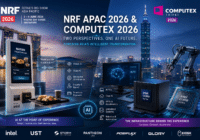
June 2026 will place Asia at the center of two major technology conversations. In Singapore, retail leaders, kiosk vendors, AI software companies, and self-service innovators will gather at NRF 2026: Retail’s Big Show Asia Pacific. At nearly the same time in Taipei, the global computing industry will converge at Computex 2026 to showcase the next generation of AI infrastructure, edge computing,… Read More »
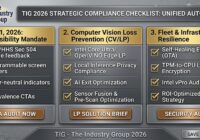
In 2026, compliance is no longer a legal review process—it is a system architecture decision. Organizations deploying kiosks, self-checkout, or unattended retail must now design for accessibility, AI-driven loss prevention, and zero-trust security from day one. This checklist is not theoretical. It reflects what regulators, auditors, and operations teams will actually enforce in production environments. The 2026 compliance landscape has moved from “best practice” to legal mandate, with a specific focus on two areas: the May 11, 2026, HHS Section 504 deadline and the shift toward Computer Vision (CV) as the standard for loss prevention. Below is the consolidated 2026 Strategic Compliance Checklist derived from recent industry guides and regulatory updates. “2026 compliance = accessibility + edge AI + zero trust” “Design-time requirement, not retrofit” “Failure = legal exposure + operational breakdown” 1 Healthcare & Public Access (The May 11 Deadline) The HHS Section 504 rule is the most immediate regulatory hurdle for organizations with 15+ employees. [ ] Tactile Integration: Kiosks must be operable by keyboard or tactile input alone; scheduling and payment interfaces cannot rely on touch-only or mouse-driven flows. [ ] Non-Visual Feedback: Images, diagrams, and status indicators (like error alerts) must have meaningful audio descriptions or “programmatically associated” labels for screen readers. [ ] Color Neutrality: Critical information (e.g., “Required Field” or “Transaction Failed”) cannot be conveyed by color alone (e.g., just turning the box red). [ ] Privacy Equivalence: Alternative procedures for those who cannot use a kiosk must afford the same level of confidentiality and convenience as the digital transaction. 2 Retail Shrink & AI Loss Prevention (The “Edge AI” Standard) Retail shrink—now exceeding $100B annually—has moved Computer Vision from pilot to required infrastructure. [ ] Sensor Fusion (The “Anti-Swap” Protocol): Move beyond simple weight scales. Systems must now integrate CV with transactional data to detect “ticket switching” or “mismatched item” events in real-time. [ ] Local Inference (Privacy Compliance): To meet 2026 data privacy standards, CV must run on Edge AI hardware (e.g., Intel Core Ultra with OpenVINO). PHI and biometric data should be processed on the device, not streamed to the cloud. [ ] AI Exit Compatibility: Packaging and labeling must be optimized for “Scan & Go” AI exit systems to reduce manual employee checks at the door. [ ] “Pre-Scan” Optimization: Ensure kiosk workflows are compatible with “pre-scan” technologies used by staff to assist high-volume checkout zones. 3 Operational Resilience & Security With $400B in annual downtime losses, “Infrastructure-Grade” kiosks must meet new Resilience Standards. [ ] Self-Healing Endpoints: Kiosks must be configured with “Persistence” technology that allows security software to autonomously reinstall or repair itself if tampered with physically or remotely. [ ] Zero-Trust Policy Sync: Fleet management (UEM) must enforce identical security and accessibility configurations across the entire fleet (Windows, Android, or iPadOS) over-the-air (OTA). [ ] TPM-to-CPU Encryption: Protect against “bus attacks” on unattended terminals by ensuring hardware-level encryption of the link between the Trusted Platform Module and the CPU. Pro Tip — If you spec Dell / HP / Lenovo inside kiosks: You are almost always getting firmware TPM You don’t control TPM vendor anymore If you need: FIPS certification Hardware isolation High-assurance identity Then you must explicitly spec: Industrial board (Advantech, AAEON, etc.) With Infineon / Nuvoton discrete TPM Discrete TPM (Infineon, Nuvoton, ST) — Was the Default: Still critical But now only in regulated, embedded, or long-lifecycle deployments Top 4 Failure Modes (2026) Retrofitting accessibility instead of designing it in Cloud-dependent AI violating privacy expectations Consumer hardware deployed in 5–7 year lifecycle environments… Read More »
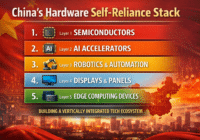
China’s Five-Year Plan (2026–2030) prioritizes technological self-reliance in critical hardware sectors including integrated circuits, sensors, robotics, and edge computing systems. The policy aims to reduce reliance on foreign supply chains while accelerating domestic innovation in components used in kiosks, PCs, and smart terminals. Key Takeaway: China’s technology strategy is shifting from supply-chain dependence toward vertically integrated domestic hardware ecosystems. Strategic… Read More »