

Smart Lockers in China
China’s rapid e-commerce growth has created a new logistics challenge: the “last meter” of delivery—the final step between the courier and the customer.
In dense cities filled with high-rise apartments, gated residential compounds, and large office complexes, traditional door-to-door delivery can be inefficient and expensive.
Smart lockers have emerged as a practical solution.
Across China, automated parcel lockers now operate as 24/7 self-service delivery infrastructure, allowing consumers to collect packages, groceries, meals, and even pharmaceuticals at convenient locations.
Key Takeaway: Smart lockers combine modular hardware, IoT monitoring, and digital access systems to transform the final stage of urban logistics.
Smart Tip — Careful with costs. For example, when exporting to regions with lower income expectations, such as Africa or Southeast Asia, the cost for a complete setup (master locker + slave locker) can be around USD 1,800. In contrast, in markets such as the United States or Europe, the typical price range is closer to USD 3,500.The most expensive project I have handled was around USD 4,300, where the locker was equipped with a printing machine and a POS terminal. However, this type of configuration is relatively rare, as most clients prefer to keep costs low in order to deploy lockers across as many locations as possible.
The Urban Logistics Problem Driving Locker Adoption
China is the world’s largest e-commerce market. Annual parcel volume exceeded 130 billion shipments in 2025, according to industry estimates from the China E-Commerce Logistics Alliance.
As online retail continues to expand, courier companies face several operational challenges:
- Failed delivery attempts when customers are not home
- High labor costs for door-to-door delivery
- Traffic congestion in dense urban areas
- Security issues for unattended parcels
These challenges have accelerated the deployment of centralized delivery infrastructure such as smart lockers located in residential communities, office parks, and retail centers.
The Smart Locker Ecosystem in China
Several companies have built large nationwide locker networks.
The largest is Hive Box, which operates more than one million smart locker units across Chinese cities.
Other technology suppliers include:
- Zhilai Tech – modular locker hardware and refrigeration systems
- Intel – processors used in embedded computing platforms within kiosks and lockers
Industry analysts from Cognitive Market Research estimate that smart lockers currently handle 15–20% of urban e-commerce deliveries in major Chinese cities, with adoption projected to reach 25% in high-density areas within the next few years.
Why Smart Lockers Work: Hardware and Technology
Smart lockers operate as self-service kiosks integrated with logistics software and cloud platforms.
The technology stack typically includes several hardware and software components.
Modular Locker Hardware
Smart lockers use modular compartment systems designed to accommodate different types of deliveries.
Configurations often include:
- small compartments for parcels
- medium compartments for retail packages
- large compartments for groceries and bulk deliveries
This flexibility reduces failed delivery attempts by 15–25% in many residential complexes.
IoT Monitoring and Cloud Management
Most smart locker systems incorporate IoT sensors and cloud connectivity.
These features allow operators to monitor:
- locker occupancy levels
- environmental conditions
- usage patterns across locations
Real-time data enables courier companies to optimize delivery routes, which can reduce logistics labor costs by 10–20%.
Thermal Control for Food and Pharmaceutical Deliveries
As locker usage expands beyond parcels, temperature-controlled storage has become increasingly important.
Refrigerated locker modules can maintain stable temperatures suitable for:
- fresh groceries
- ready-to-eat meals
- pharmaceutical products
According to industry data, temperature-controlled lockers reduce spoilage losses by 5–10% compared with traditional unattended delivery.
Mobile and Touchless Access
Smart locker systems typically integrate with mobile apps, enabling customers to unlock compartments via QR codes or digital authentication.
Touchless retrieval reduces wait times and improves customer convenience, contributing to adoption rates growing 20–30% annually in many residential communities.
Expanding Use Cases Beyond Parcel Delivery
While parcel delivery remains the primary use case, China’s smart locker networks are expanding into several new service areas.
These include:
- grocery delivery
- meal pickup from restaurants
- pharmaceutical distribution
- document exchange in office buildings
Multi-purpose lockers that handle both parcels and food deliveries show 15–20% higher utilization rates than parcel-only systems.
This trend reflects the increasing demand for integrated urban delivery infrastructure.
Global Implications for the Self-Service Industry
China’s smart locker ecosystem offers important lessons for the global self-service technology industry.
Smart lockers share many architectural similarities with self-service kiosks, including:
- touchscreen interfaces
- embedded computing systems
- IoT connectivity
- digital authentication
As a result, many kiosk hardware suppliers are also entering the smart locker market.
China’s dominance in several hardware components—including display panels, embedded PCs, and IoT devices—gives its manufacturers a strong position in this growing sector.
The smart locker model is now expanding internationally, with deployments appearing in:
- Europe
- Southeast Asia
- North America
As cities worldwide face similar last-mile delivery challenges, automated pickup infrastructure may become a standard component of urban logistics systems.
Conclusion: Smart Lockers as Urban Infrastructure
China’s smart locker networks demonstrate how hardware innovation, IoT connectivity, and logistics integration can solve one of the most persistent challenges in modern e-commerce: the last meter of delivery.
By consolidating deliveries at centralized pickup points, lockers reduce operational costs, improve courier efficiency, and enhance convenience for consumers.
As parcel volumes continue to grow globally, China’s smart locker ecosystem may serve as a blueprint for cities seeking to modernize their urban logistics infrastructure
China Smart Locker Market — Key Metrics (2024–2026)
Core Market & Deployment
-
Estimated share of global deployments: Asia-Pacific (led by China) is one of the fastest-growing regions, driven by e-commerce scale
-
Urban penetration: Tier 1–2 cities approaching “default infrastructure” status in residential compounds
-
Locker density (top cities): Global benchmark ~450 lockers per 100K people (China metros are at/above this in dense zones)
- https://www.marketreportsworld.com/market-reports/intelligent-parcel-locker-market-14722369
Volume & Throughput
-
China is part of the 1.5B+ parcels annually processed via lockers globally
-
High-frequency usage driven by:
-
JD / Alibaba logistics ecosystems
-
Same-day / next-hour delivery expectations
- https://www.marketreportsworld.com/market-reports/intelligent-parcel-locker-market-14722369
-
Adoption Drivers
-
E-commerce dominance: China leads global parcel volume (>100B parcels annually overall ecosystem)
-
Labor economics: lockers reduce last-mile labor dependency
-
Residential integration: lockers embedded in:
-
apartment complexes
-
transit hubs
-
campus-style developments
-
Behavioral Metrics
-
Locker usage in China is often:
-
Default delivery option, not alternative
-
Heavily integrated with QR/mobile-first workflows
-
Technology Layer
-
Higher penetration of:
-
AI-enabled access / facial recognition
-
Mobile super-app integration (WeChat, Alipay)
-
-
Strong domestic OEM ecosystem (e.g., Zhilai Tech, China Post)
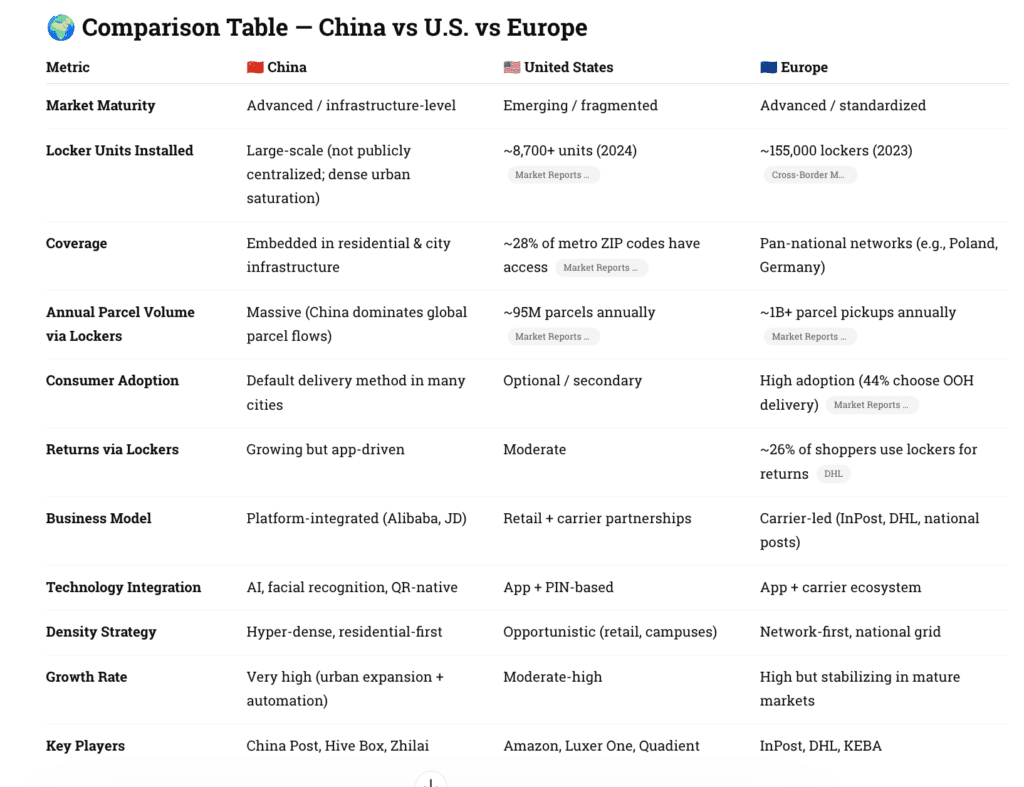
Comparison China vs US vs Europe
Figure 400,000 in China.
Smart lockers China
Strategic Takeaways (TIG Executive Layer)
1. China = “Infrastructure Model”
-
Smart lockers are built into daily life
-
Comparable to:
-
elevators
-
mailrooms
-
-
Strong linkage to super-app ecosystems
2. Europe = “Network Model”
-
Highly structured carrier-driven networks
-
Example:
-
Poland alone → 30,000+ lockers
-
-
Strong consumer adoption for both delivery and returns
3. U.S. = “Fragmented / Opportunity Model”
-
Adoption exists but:
-
not standardized
-
not default behavior
-
-
Strong upside in:
-
multifamily housing
-
BOPIS / retail integration
-
End of content