Strategic Takeaway
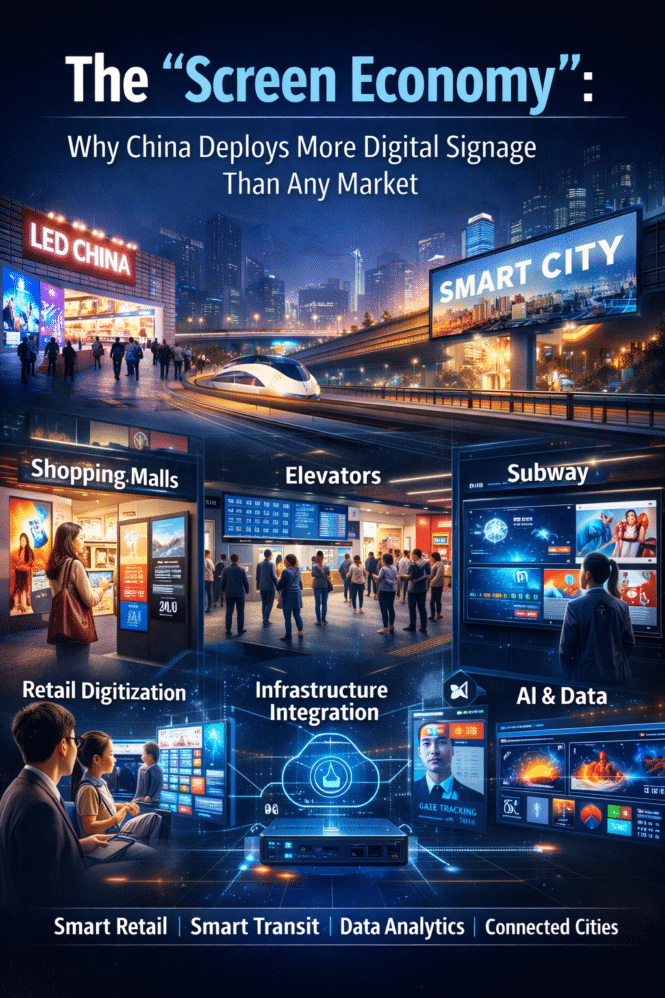
China is rapidly becoming one of the highest-density digital signage markets in the world—not just in scale, but in how deeply screens are embedded into everyday urban life.
Craig Allen Keefner comment — “As someone who’s watched the kiosk and digital signage market from both the US and Shenzhen, I think this piece captures a key point: in China, screens aren’t just ‘displays’—they’re infrastructure. Government‑backed urban projects, dominant domestic panel manufacturing, and fast procurement cycles mean DOOH and retail signage can scale at a speed Western integrators still find hard to match. The next competitive battleground is less about hardware price and more about software, data rights, and who controls the monetization layer on top of these nationwide screen networks.”
A Country Built on Screens
Walk through any major Chinese city and the pattern is unmistakable:
- Shopping malls filled with dynamic LED walls
- Elevators streaming hyper-local ads
- Subway systems delivering real-time information
- Convenience stores running programmatic promotions
- Restaurants replacing static menus with digital displays
This is not just adoption—it is saturation. China is no longer experimenting with digital signage; it is operationalizing it at national scale.
From Hardware to Infrastructure: The Rise of the Screen Economy
The global digital signage market reflects this transformation. Valued at $31.09 billion in 2025, it is projected to reach $58.42 billion by 2033, growing at a CAGR of 8.2%.
While North America currently holds the largest revenue share (35.6%), Asia-Pacific is the fastest-growing region, with China at its core. Grandview
What differentiates China is not just demand—but deployment logic:
- Screens are treated as infrastructure, not marketing tools
- Hardware (59% of market share) is tightly integrated with software ecosystems
- Media players and mini PCs are deployed at scale for centralized control
This creates a network effect: the more screens installed, the more valuable the network becomes.
Why China Leads: Four Structural Drivers
1. High-Density Urban Environments
China’s megacities—Shanghai, Shenzhen, Beijing—provide the ideal conditions for digital signage:
- Massive foot traffic
- Enclosed commercial ecosystems (malls, transit hubs)
- High-frequency consumer exposure
In these environments, screens outperform static advertising by delivering dynamic, real-time content to millions daily.
2. Retail Digitization at Scale
Retail is the largest application segment globally—and China is pushing it further.
Digital signage in retail can increase foot traffic by up to 24% [Rise], particularly when multiple screens are deployed. Chinese retailers leverage this through:
- Real-time promotions
- Interactive kiosks (32–52 inch segment dominance)
- Integrated online–offline campaigns
This aligns with China’s broader “New Retail” strategy—where physical stores act as data-driven media environments.
3. Government & Infrastructure Integration
Unlike fragmented Western markets, China benefits from top-down digital infrastructure planning.
Initiatives such as the Digital Silk Road extend beyond connectivity—they enable:
- Smart city deployments
- Public information systems
- Transportation-based signage networks
Subways, stations, and airports rely heavily on video walls (25.5% market share) for:
- Real-time scheduling
- Emergency communication
- Passenger navigation
In cities like Tokyo this is already critical—but China is scaling it faster and broader.
4. Technology Stack Maturity (Hardware + Software + AI)
China’s dominance is also technological:
- Rapid adoption of 4K and emerging 8K displays
- Expansion of LED and transparent screens (80%+ transparency)
- Integration of AI-driven analytics (e.g., gaze tracking, heat mapping)
These systems are powered by:
- Embedded media players
- Industrial mini PCs
- Cloud-based content management systems
The result is not just display—but intelligent signage networks.
Technology Stack for Mini-PC and Media Players
- content management
- remote monitoring
- device management
- network connectivity
- local/edge compute
- maintenance/service model
- replacement cycle / lifecycle planning
- Intel Ultra, Intel older gen, Amazon stick and Raspberry Pi – depending on requirements
China Digital Signage Market: Why Events Matter
A key indicator of China’s leadership is its industrial ecosystem—anchored by events like LED CHINA.https://www.ledchina.com/
- Established in 2005, it is one of the earliest LED-focused trade shows globally
- The 2026 Shenzhen edition attracted attendees from 132 countries
- The Shanghai edition reached 157 countries
- Widely regarded as a “barometer” of the global LED display industry
Its “Spring and Autumn Dual Exhibition” strategy integrates multiple sectors:
- Digital signage
- Printing
- Smart display
- Professional lighting
This reflects China’s “1+N industrial synergy model”—where signage is not standalone, but part of a broader visual communication ecosystem.
Beyond Advertising: The Evolution of Use Cases
Digital signage in China is no longer just about ads. It is evolving into multi-functional digital infrastructure:
1. Smart Retail Media Networks
Retail stores are becoming mini broadcasting stations, running programmatic campaigns based on:
- Time of day
- Customer demographics
- Real-time inventory
2. Self-Service & Automation
Interactive kiosks streamline:
- Ordering
- Ticketing
- Check-ins
Reducing labor costs while improving user experience.
3. Data Collection & Behavioral Analytics
Advanced systems now include:
- Gaze tracking
- Crowd density mapping
- Heat path analysis
This turns screens into data sensors, feeding back into marketing and operations.
4. Sustainability & Energy Efficiency
Innovations like E Ink-based signage (e.g., low-energy ePosters) highlight a shift toward:
- Reduced power consumption
- Replacement of paper-based advertising
- Long-term operational efficiency
China represents both:
- The largest deployment environment
- And the most advanced use-case laboratory
As global markets move toward integrated, data-driven signage networks, China is not just participating—it is setting the pace.
5. Infrastructure, why operators should do this economically
- labor leverage
- ad monetization
- improved sell-through/promotions
- reduced print/sign change costs
- data collection value
- centralized campaign execution
More Resources
- Interactive Digital Software by Sitekiosk
- Facial Recognition Buyer’s Guide and Executive Checklist
- Intel Core Ultra Series 3 with Intel vPro
- NRA National Restaurant Show
- CareU service simulates everyday kiosk environments to help seniors gain confidence
- 2026 Strategic Compliance Checklist
- Giada Showcases Embedded Computing Innovations at Embedded World 2026


