
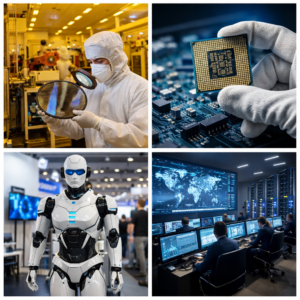

China’s 15th Five-Year Plan (2026–2030) prioritizes technological self-reliance in critical hardware sectors including integrated circuits, sensors, robotics, and edge computing systems. The policy aims to reduce reliance on foreign supply chains while accelerating domestic innovation in components used in kiosks, PCs, and smart terminals.
Key Takeaway: China’s technology strategy is shifting from supply-chain dependence toward vertically integrated domestic hardware ecosystems.
Strategic Context: China’s Push for Technological Independence
China’s newly released 15th Five-Year Plan outlines a national strategy to strengthen technological sovereignty in response to increasing global supply-chain tensions. Government policy documents released in early 2026 emphasize the need for “extraordinary measures” to achieve breakthroughs in integrated circuits and emerging technologies such as embodied AI and robotics.
For industries reliant on digital infrastructure—including self-service kiosks, thin clients, and industrial PCs—these policy priorities are particularly significant. Technology ecosystems involving companies such as Intel, NVIDIA, and numerous Chinese semiconductor manufacturers are closely watching how China restructures its domestic supply chain.
Integrated Circuits and Edge Computing Hardware
A core pillar of the new plan is the expansion of China’s domestic integrated circuit (IC) industry. Investments are being directed toward advanced semiconductor manufacturing, chip design, and packaging technologies.
This push is expected to influence several hardware categories relevant to the self-service industry:
-
Industrial PCs and embedded systems
-
Thin clients and edge-computing devices
-
AI-enabled kiosks and service terminals
By strengthening local semiconductor production, China aims to reduce dependency on imported processors and accelerate the development of specialized chips optimized for AI inference and edge workloads.
Embodied AI and Robotics Development
Another notable priority within the plan is embodied AI, which refers to artificial intelligence integrated into physical systems such as humanoid robots and intelligent machines.
These technologies are expected to influence multiple sectors:
-
Automated retail environments
-
Smart hospital service systems
-
Logistics and warehouse automation
-
Public service and transportation terminals
For the kiosk and self-service industries, embodied AI could lead to more interactive service environments where robots and smart terminals operate together as part of a unified digital infrastructure.
Market Impact on Global Hardware Competition
China’s long-term investment in semiconductor manufacturing and intelligent hardware could significantly reshape global pricing and innovation dynamics. By expanding domestic production of components such as processors, sensors, and industrial controllers, Chinese manufacturers may reduce hardware costs and accelerate development cycles.
Industry analysts suggest that this strategy could allow Chinese hardware producers to compete aggressively in international markets, particularly in sectors such as kiosks, thin clients, and embedded computing systems.
Conclusion: A Structural Shift in Global Hardware Innovation
China’s 15th Five-Year Plan signals a decisive shift toward technology self-reliance and vertically integrated hardware ecosystems. By prioritizing semiconductors, sensors, robotics, and AI-enabled infrastructure, the country is positioning itself to expand its role in global digital hardware markets.
For the self-service technology sector, these developments could influence everything from kiosk component sourcing to the evolution of AI-enabled terminals, making China a central driver of next-generation hardware innovation.


