
The Smart Cinema in China industry is undergoing a rapid transformation—from traditional exhibition spaces into fully digitized, self-service, AI-driven environments. On the computer side note the shift toward Intel Core Ultra (NPU-equipped) mini-PCs inside these kiosks to handle real-time demographic recognition and gaze analysis without high latency or massive cloud egress costs.
Our Executive Takeaway
By Craig Allen Keefner — China’s cinema industry is quietly becoming one of the most advanced real-world deployments of integrated self-service infrastructure at scale. What looks like a simple ticketing upgrade is actually a full-stack transformation—combining kiosks, mobile, AI inference, and cloud orchestration into a unified operating model.
At the front end, self-service ticketing terminals have largely eliminated traditional box office friction. Customers select seats, pay, and retrieve tickets (or QR credentials) in seconds. More importantly, these systems are not standalone—they are tightly integrated with mobile apps, loyalty platforms, and real-time pricing engines. This is not “kiosk as device.” This is kiosk as endpoint in a larger digital ecosystem.
The bigger story is in the lobby. Digital signage and AI-enabled media players are turning idle space into a programmable revenue channel. Content is dynamically adjusted based on time of day, audience composition, and local demand signals. With edge AI (including platforms aligned with Intel’s Core Ultra direction), inference can be done locally—reducing latency, improving uptime, and addressing data control concerns.
Operationally, the model drives measurable outcomes: reduced labor dependency, higher concession attach rates, and improved throughput during peak periods. But the strategic shift is more important—cinemas are evolving into data-driven retail environments, where every interaction is captured, analyzed, and monetized.
The takeaway for operators globally is straightforward: China is not experimenting—it is operationalizing at scale. The cinema is no longer just a venue. It is a digitally managed, self-service platform—and increasingly, a high-margin media and data business.
Driven by large-scale adoption of ticketing terminals and AI-powered digital advertising screens, cinemas are evolving into high-efficiency, data-driven commercial spaces.
At the center of this shift are platforms like Alibaba Pictures, which are integrating SaaS systems, automation hardware, and AI marketing into a unified operational model.
Traffic at Scale Enables Digitalization
China’s cinema market provides the foundational condition for this transformation: massive offline traffic.
- In 2025, China’s box office reached RMB 51.83 billion, representing approximately 22% year-on-year growth
- China contributed nearly 24% of global box office revenue, reinforcing its position as one of the world’s largest cinema markets xinhua
This level of foot traffic creates a high-value environment where:
- Self-service systems can significantly improve throughput
- AI advertising can achieve meaningful scale and ROI
- Data-driven operations can continuously optimize performance
Without this scale, such investments would not be economically viable.
From Ticket Counters to Self-Service Infrastructure
The Rise of Ticketing Terminals
Chinese cinemas have widely adopted self-service ticketing terminals, enabling:
- Ticket purchase
- QR code-based pickup
- Seat selection
- Membership integration
These systems are no longer standalone kiosks—they are part of a connected operational infrastructure.
With AI integration, ticketing terminals now support:
- Dynamic seat pricing
- Demand forecasting
- User behavior tracking
According to industry estimates, automation through self-service terminals can reduce up to 60% of front-desk labor costs, while significantly improving peak-hour efficiency.
AI as the Core Operating Layer
The next phase of cinema digitalization is defined by AI.
By 2026, the global AI market in cinema operations is projected to reach $1.72 billion, driven by:
- Real-time audience behavior analysis
- Automated ticketing systems
- Predictive maintenance for equipment
AI is no longer a backend optimization tool—it is becoming the core decision-making layer across cinema operations.Researchandmarkets
The Monetization Engine: AI-Powered Digital Signage
From Static Screens to Intelligent Media Players
One of the most important upgrades inside Chinese cinemas is the shift from traditional posters to AI-powered digital advertising screens (media players).
These systems are increasingly integrated with:
- Computer vision
- Demographic recognition
- Real-time content delivery systems
This enables cinemas to deliver programmatic DOOH (Digital Out-of-Home) advertising.
We should note that while these systems use computer vision for demographic recognition, they are designed with on-device processing to comply with China’s strict data security and algorithm filing requirements.
High-Impact Moment: The 3–5 Minute Window
The most valuable advertising window in a cinema is often overlooked:
the 3–5 minutes when users interact with ticketing terminals or wait in the lobby.
During this time, AI systems can:
- Analyze audience demographics
- Detect behavioral signals
- Dynamically adjust ad content
According to industry reports, AI-driven marketing systems in China have improved ROI by up to 300%, with over 50% of advertisers already integrating AIGC into routine campaigns.DCHBI
This transforms cinema lobbies into:
High-precision, high-conversion advertising environments
Platform Integration: The Role of Cloud-Based Systems
The real breakthrough in China’s smart cinema model lies in system-level integration.
Solutions like “Fenghuang Yunzhi” from Alibaba Pictures demonstrate how cloud platforms can unify:
- Ticketing terminals
- Access control gates
- Concession systems
- Digital advertising screens
This creates a centralized SaaS control layer that enables:
- Remote management
- Real-time data synchronization
- Automated operations
The result is a cinema lobby that can operate with minimal or even zero on-site staff.
Why China’s Model Works
1. High Traffic + High Frequency
China’s cinema density and audience volume create a perfect environment for:
- Rapid ROI on automation
- Scalable advertising monetization
- Continuous data collection
2. Seamless Payment Integration
Self-service terminals are tightly integrated with mobile payment ecosystems, especially Alipay and WeChat.
This enables:
- Instant transactions
- Reduced queue times
- Higher conversion rates
Payment friction—one of the biggest bottlenecks globally—is effectively eliminated.
3. Hardware + Software Integration
China’s advantage is not just adoption—it is integration.
Instead of fragmented systems, leading operators deploy:
- Unified SaaS platforms
- Connected hardware networks
- AI-driven analytics
This “full-stack” approach ensures that every device—from kiosks to screens—works as part of a single system.
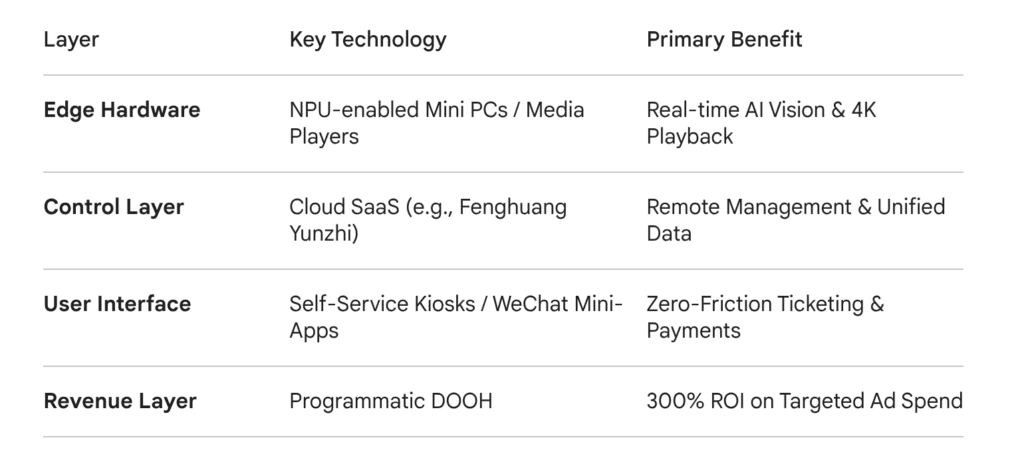
Stack tech
4. AI-Driven Revenue Expansion
Unlike traditional cinemas that rely primarily on ticket sales, China’s smart cinemas generate value through:
- Advertising
- Data insights
- Cross-platform engagement
AI turns cinema spaces into media assets, not just entertainment venues.
Strategic Implications for Industry Players
For Cinema Operators
- Automation is no longer optional—it is a cost and efficiency baseline
- AI-driven advertising represents a major new revenue stream
- Data integration will define competitive advantage
For Hardware & Solution Providers
- Demand is shifting from standalone devices to integrated systems
- Key opportunities lie in:
- Media players
- AI analytics
- Cloud-based management platforms
For Global Markets
China offers a clear blueprint:
Self-service + AI + digital payments + SaaS integration = scalable smart cinema
However, replication will depend on:
- Payment infrastructure maturity
- Data regulation environments
- Market scale
Smart Cinema in China Conclusion
China’s cinema industry is no longer just digitizing—it is redefining the role of physical entertainment spaces.
Through the integration of:
- Ticketing terminals
- AI-powered media players
- Cloud-based operational platforms
Cinemas are evolving into:
Intelligent, automated, revenue-optimized environments
The key takeaway for B2B stakeholders is clear:
The future of cinema is not just about content—it is about infrastructure.
More Smart Cinema in China Resources
- Healthcare in Shanghai – Kiosks and AI
- China’s QR Code Economy Built the Perfect Environment for Self-Service
- The “Screen Economy”: Why China Deploys More Digital Signage Than Any Market
- Interactive Digital Software by Sitekiosk
- Facial Recognition Buyer’s Guide and Executive Checklist
- Intel Core Ultra Series 3 with Intel vPro
- NRA National Restaurant Show