
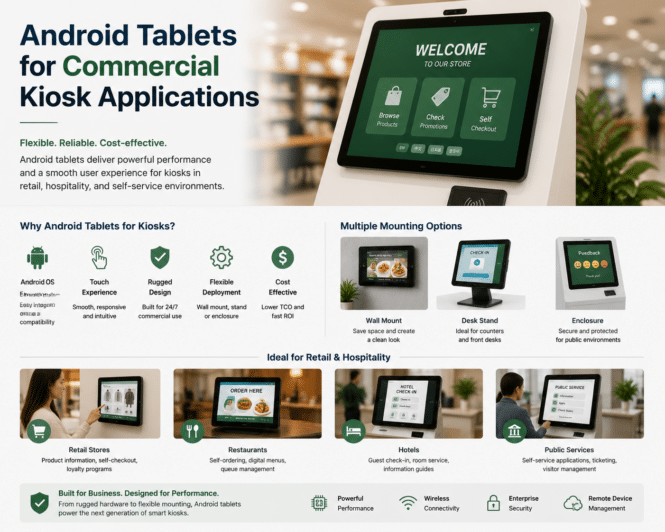
An Android tablet is not automatically a commercial kiosk platform. It may be appropriate for light-duty visitor check-in, staff-facing applications, meeting-room control, product lookup, or temporary deployments. But unattended public kiosks, self-order stations, payment systems, outdoor environments, and 24/7 deployments often require purpose-built tablet hardware or a kiosk PC/industrial Android device with documented thermal design, power management, remote support, long-term OS maintenance, and peripheral integration.
A sophisticated buyer needs answers to questions such as:
-
Is the tablet consumer-grade, ruggedized, or genuinely commercial/industrial?
-
What Android version ships with it, and for how long will it receive security patches?
-
Does it have Google Mobile Services, Android Enterprise compatibility, or an AOSP-based operating system?
-
Can it run in portrait orientation 16–24 hours a day without battery swelling, thermal throttling, display retention, or charging failure?
-
Can the battery be removed, bypassed, or managed safely in a permanently powered kiosk?
-
Does it support Ethernet, Power over Ethernet, USB peripherals, serial adapters, NFC, payment terminals, barcode scanners, printers, cameras, and receipt printers?
-
Can it be locked down using an MDM/EMM platform or kiosk-mode software?
-
Is there a documented product lifecycle, spare-parts program, warranty, repair process, and end-of-life notice?
-
Is the device appropriate for payment, healthcare, government, outdoor, or accessibility-sensitive deployments?
Industry Perspective –
The mistake is treating an Android tablet as a commodity component. For a temporary check-in station, almost any well-managed tablet may work. For a payment kiosk expected to operate unattended for five years, the important questions are thermal design, power management, peripheral support, security updates and product lifecycle. The low-cost consumer-grade tablet can quickly become the most expensive option once field service and replacement costs are included. Look at Amazon and then look at GloryStar.
Consider consumer-grade MS Surface units, which do not have an industrial version. See custom kiosks and all the trouble 80 Surface units failing incoming QA. Microsoft has no RMA policy mechanism. Pegatron manufactures the units and historically assembled them in China, but recently, due to tariffs, they expanded assembly to Vietnam to save Microsoft some money.
iPads suffer from “next year’s model” syndrome as well. For that matter, so do corporate-grade Dell or HP computers. One-time short-term projects, people say go ahead and use consumer-grade. Even in the short term, you will likely regret it.
Been there — done that.
Decision table
More Resources
- Best Touchscreen Monitor Manufacturers in Asia for Kiosks and Interactive Displays
- AI Kiosks Are Transforming Public Services: Vietnam’s Smart Government Takes a Step Forward
- Public Kiosk in Vietnam that is total AI and totally useful
- Alibaba New Retail
- Edge Computing in Self-Service: Why Asia Leads Embedded AI
- Mini PCs for Kiosks and Digital Signage: Top Asian Manufacturers for 2026