
By Craig Allen Keefner
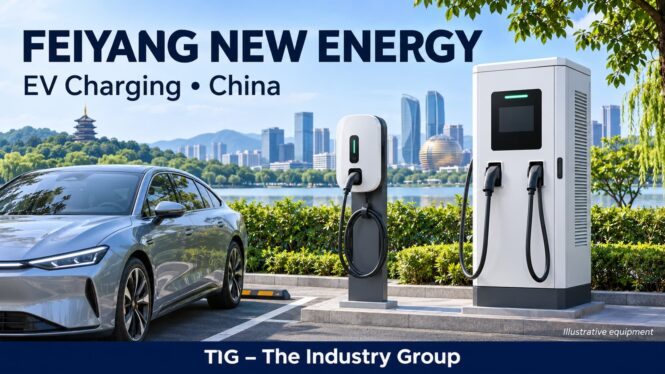
Hangzhou Feiyang New Energy Co., Ltd. develops and supplies electric vehicle charging equipment for residential, commercial and public charging applications. Based in Hangzhou’s Lin’an District in Zhejiang, China, the company describes its business as integrating research, manufacturing, sales and service.
Craig’s Insight
For the self-service industry, the interesting part of EV charging is the complete transaction: finding an available charger, connecting, authorizing payment and getting help when something fails. My view is that Feiyang’s relevance to distributors and integrators will depend on how well its equipment fits that operating environment. Hardware specifications start the discussion; software compatibility, service and a usable customer interface determine the long-term value.
Products and Applications
Feiyang markets equipment under the FLYING name. Its portfolio includes AC chargers, DC fast chargers, portable charging equipment, accessories and energy storage systems. The company targets homes, workplaces, hotels, commercial properties, fleet operations and public charging locations, and advertises OEM/ODM customization for partners.
| Product area | Listed specifications |
|---|---|
| AC charging | 7, 11 and 22 kW configurations |
| AC interfaces | Type 1, Type 2 and GB/T options |
| AC controls | Wi-Fi/app monitoring, scheduled charging and adjustable current |
| AC enclosure and display | IP55 rating and a 2.8-inch status display |
| Compact DC charging | 20, 30 and 40 kW models |
| Larger DC charging | Product families extending to 240 kW |
| DC connections | CCS1/CCS2 options listed in the catalog |
Specifications depend on the selected model and configuration. These are manufacturer-published ratings rather than independently tested results. See the company’s AC charger specifications and DC charger catalog.
Load Management and Customization
Feiyang describes a dynamic load balancing system that measures a building’s electrical demand and adjusts charging current to available capacity. Its published architecture uses a smart meter or current collector connected to the charger through RS485/Modbus RTU.
The company also advertises in-house circuit board and firmware development, Tuya app integration, customized interfaces, language options and partner branding. These capabilities position its offering toward distributors and businesses seeking chargers configured for their own markets. Read its dynamic load balancing overview.
Brand and Market Verification
A Philippine Intellectual Property Office publication lists Hangzhou Feiyang New Energy as the applicant for the FLYINGEVSE trademark, filed April 30, 2026. The application covers EV charging equipment and related electrical products. This provides a public record linking the company to the brand; it does not establish deployment volume or product certification. Source: IPOPHL trademark publication, June 1, 2026.
For prospective partners, the next useful evidence would be named installations, model-specific certification documents, demonstrated backend interoperability, payment options and regional service arrangements.
Company website: Hangzhou Feiyang New Energy


