
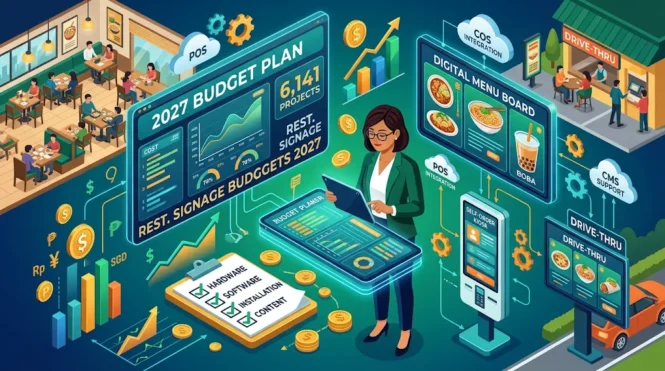
Restaurant signage budgets should cover more than screens. A useful plan separates the cost of individual components, installation projects, complete store packages, and the ongoing expense of operating a digital network.
Research from The Howard Company, based on 6,141 projects, provides a reference point: median purchase-order values ranged from approximately US$4,800 to US$11,800, depending on the number of locations operated by the customer. These are historical project benchmarks—not complete per-store budgets, Asian market prices, or forecasts of 2027 equipment costs.
For Kiosks Asia readers, the value is less about converting those figures into local currency and more about understanding what belongs in the budget. Digital menu boards, ordering kiosks, POS integration, content management, and installation need to be considered together without assuming they all fall within the same supplier’s quote.
Start With the Right Budget Question
“How much does restaurant signage cost?” can describe four very different purchases.
| Budget level | What it measures | What to clarify |
|---|---|---|
| Component | One display, enclosure, menu board, or sign | Does the price include mounting, a media player, and software? |
| Project | A purchase order for a site or rollout phase | Is this a complete installation or only part of the work? |
| Store package | The visual systems required for one location | Are exterior signs, indoor boards, drive-thru displays, and installation included? |
| Fleet program | Annual spending across multiple locations | Does it include new stores, refreshes, replacements, subscriptions, and support? |
The Howard Company’s research distinguishes these levels because they are not interchangeable. A project median cannot be treated as the cost of equipping a complete restaurant—or multiplied by the entire store count to produce a defensible annual budget.
For operators preparing a 2027 plan, the first task is therefore to define the scope, not select a screen.
What the Project Data Shows
The company analyzed invoiced order records from fiscal 2022 through fiscal 2026 year to date. Its published figures show substantial variation by customer size.
| Locations operated by customer | Median project value | 90th-percentile project value |
|---|---|---|
| 1–5 | US$11,780 | US$31,613 |
| 6–24 | US$4,828 | US$25,495 |
| 25–75 | US$10,098 | US$34,702 |
| 76–300 | US$9,105 | US$35,911 |
| 301–1,000 | US$11,180 | US$19,025 |
| 1,000+ | US$6,049 | US$13,523 |
Source: The Howard Company’s analysis of 6,141 projects. The sample represents one manufacturer’s order book, not a market-wide survey. Values are in US dollars.
The largest operators did not record the lowest median, but their US$6,049 median was roughly half that of customers operating one to five locations. The company attributes this pattern to differences in purchasing organization and project scope: large programs may be divided into multiple orders, while a small operator may buy a broader package at once. That explanation should be treated as the supplier’s interpretation, rather than proof of a pricing advantage.
The practical takeaway is straightforward: compare the contents of the purchase order before comparing its total.
Why Store Format Matters More Than a Headline Price
The source article illustrates the scope problem through two US franchise disclosures.
According to The Howard Company’s review, Culver’s 2026 disclosure lists a sign package of US$88,000–US$300,000 covering interior and exterior signs, digital menu boards, and installation. Wingstop’s 2025 disclosure lists US$4,200–US$25,100 for standard exterior signage, including shipping, but excluding interior signage.
Those figures describe different buildings and different packages. One should not be used to judge whether the other is expensive.
For an Asia-focused procurement brief, the same distinction should guide the questions asked of suppliers. Define whether the project is a mall restaurant, leased shopfront, freestanding site, or drive-thru. Then specify which structures, permissions, electrical works, and installation services belong inside the quotation.
Currency conversion comes after that scope exercise—not before it.
Digital Menu Boards Need an Operating Budget
A digital signage purchase creates continuing work. The source identifies software, monitoring, warranty coverage, content production, integration, and eventual hardware replacement as costs that can sit outside the initial equipment quotation.
The Howard Company publishes the following reference figures:
| Cost item | Supplier’s published reference |
|---|---|
| Content management software subscription | Approximately US$200 per screen annually |
| Purchased software license | US$400–US$500 per screen, potentially with additional annual charges |
| Extended screen warranty | US$200–US$1,000 per screen for three to five years of coverage |
| Outsourced content design and updates | US$100–US$150 per hour |
These are supplier reference figures reported in the source article, not independently established Asian market rates.
For regional tenders, ask vendors to price the same operating assumptions: the same number of screens, content changes, locations, service hours, and contract years. Otherwise, a low hardware quote may simply exclude work included elsewhere.
A useful comparison is the total cost over the proposed ownership period, with hardware, software, services, and replacement assumptions shown separately.
Where Ordering Kiosks Fit
The signage dataset should not be presented as a self-ordering kiosk price benchmark. Its project medians do not establish the cost of a kiosk, payment terminal, or complete self-service ordering deployment.
However, the budgeting approach is useful when preparing a combined kiosk and signage tender. Ask suppliers to identify:
- Which system holds the authoritative menu and prices.
- Whether menu boards and kiosks use supported POS connectors.
- Whether each interface requires separate configuration or development.
- Who tests the connections after a software upgrade.
- Who owns support when several vendors are involved.
The source article makes this distinction for digital menu boards, order-confirmation displays, POS systems, and voice ordering: a connection may be an existing supported integration or a separate development project. Initial setup and ongoing maintenance are different budget items.
For a combined deployment, require an interface schedule rather than accepting “POS integrated” as a complete specification.
Budget for Content Ownership
A screen network needs someone responsible for what appears on it.
The Howard Company’s analysis distinguishes outsourced content services from in-house work. Outsourcing creates an explicit service cost; internal management consumes staff time and requires training, documentation, and backup coverage. Neither approach eliminates the workload.
For an Asia-focused tender, specify the content requirements before asking for prices:
- Required languages and versions.
- Number of menu layouts and screen orientations.
- Frequency of price and promotional changes.
- Approval responsibilities.
- Daypart schedules.
- Training and handover requirements.
These should be procurement requirements, not assumptions left for the installation team to resolve.
The budget should name both the content owner and the person authorized to approve changes.
Look Beyond “Free” or Bundled Hardware
Bundled hardware can simplify purchasing, but it should still be evaluated against the complete commercial agreement.
The source article highlights the need to compare equipment ownership, recurring subscriptions, payment-processing terms, platform dependency, and exit conditions—not just the initial display price.
Before accepting a bundled signage or kiosk proposal, request written answers to five questions:
- What is the equipment’s standalone purchase price?
- Who owns it during and after the contract?
- Can it operate with another software platform?
- Which charges continue if the restaurant stops using a feature?
- What happens to the equipment and content when the agreement ends?
The objective is not to reject bundling. It is to make an owned-equipment proposal and a subscription-led proposal comparable.
A Practical 2027 Budget Checklist
Build the annual plan from the actual deployment schedule rather than applying one average across the estate.
| Budget category | What to include |
|---|---|
| New locations | Complete packages matched to each restaurant format |
| Remodels and refreshes | Planned signage, branding, and menu-board changes |
| Hardware replacement | Displays, players, controllers, and other components due for renewal |
| Software and support | CMS subscriptions, monitoring, licenses, and service coverage |
| Content operations | Initial production, ongoing changes, translation where required, and staff time |
| Integration | Configuration, development, testing, and revalidation |
| Site works | Mounting, structural work, electrical supply, and installation |
| Connectivity | Network configuration and any separately required service |
| Contingency | Unplanned repairs and costs outside warranty |
This framework adapts the source article’s bottom-up budgeting approach. Its central point is that new equipment, recurring operations, integration, and site work belong in the same planning exercise—even when different departments pay the invoices.
To avoid double-counting, specify whether installation, warranty, and software are included in each package before adding separate allowances.
The Kiosks Asia Takeaway
The Howard Company’s research provides a useful historical reference, with an important limitation: it describes one supplier’s projects, not the cost of a complete Asian restaurant technology deployment.
For 2027 planning, use it to improve the questions in the tender. Separate project costs from store costs. Separate equipment ownership from service subscriptions. Specify integration responsibilities and content ownership before selecting the hardware.
The most useful budget is not the one with the lowest screen price. It is the one that clearly states what will be installed, what it will cost to operate, and who will keep it working.
Source: The Howard Company: How Much Should Restaurants Budget for Signage in 2027? The underlying franchise disclosures and supplier pricing have not been independently reverified for this article.

