
Updated: November 14, 2026 | By Craig Allen Keefner, Chief Editor, Kiosk Asia & The Industry Group (TIG)
TL;DR: Deploying artificial intelligence on hospital check-in and triage kiosks no longer requires streaming protected patient records to external cloud APIs. By executing small language models (SLMs), voice transcription, and computer vision directly on local edge hardware, healthcare operators across Asia-Pacific, India, and Europe satisfy strict data residency and consent mandates while eliminating network latency. Keeping inference inside the hospital perimeter turns regulatory compliance into an architectural default rather than an ongoing vendor-audit burden.
Across major hospital networks in Singapore, Tokyo, Seoul, Mumbai, and Sydney, self-service patient intake terminals are moving beyond static barcode scans and touch forms. Modern healthcare kiosks increasingly incorporate multilingual voice intake, optical character recognition (OCR) for national IDs and insurance cards, and ambient camera sensors for queue and accessibility assistance. For North American regulatory context, see our companion US analysis on Healthcare Kiosks and Local AI: Privacy, HIPAA and the Case for On-Premises Processing.
Why Cloud-First AI Creates Regulatory Friction in APAC Healthcare
When a patient speaks symptoms into a kiosk microphone or scans a government health card, routing raw audio, facial geometry, or diagnostic text to a third-party public cloud endpoint immediately triggers cross-border transfer, data processor, and retention liabilities. Unlike traditional EHR database syncs over encrypted hospital VPNs, commercial cloud LLM APIs introduce opaque logging policies, model-training exclusions that require enterprise Business Associate or Data Processing Agreements, and single points of WAN failure during peak outpatient intake hours.
- Cross-Border Transfer Restrictions: Many cloud inference regions sit outside the patient’s home jurisdiction, complicating statutory localization and transfer adequacy reviews.
- Biometric & Sensitive Data Triggers: Voiceprints, facial images, and health diagnoses fall under heightened “sensitive personal data” tiers across nearly every major Asian and European privacy regime.
- Deterministic Uptime: Outpatient registration lobbies cannot stall when external internet links degrade; local NPU and GPU inference guarantees sub-second response times offline.
Global & APAC Regulatory Landscape for Kiosk AI
Hospital IT architects and kiosk OEMs deploying across multinational footprints must design for overlapping statutory frameworks rather than a single compliance checklist:
| Jurisdiction / Framework | Primary Regulation | Impact on Healthcare Kiosk AI |
|---|---|---|
| India | Digital Personal Data Protection (DPDP) Act & ABDM Health Data Management Policy | Requires explicit, itemized patient consent before processing health data and enforces strict governance over cross-border transfers and third-party data fiduciaries. |
| China | Personal Information Protection Law (PIPL) & CAC Facial Recognition Measures | Classifies medical and biometric data as sensitive personal information; mandates separate consent, impact assessments, and defaults to on-device storage rather than cloud upload. |
| Singapore & ASEAN | Singapore PDPA & MOH Healthcare Cybersecurity / AI Governance Guidelines | Mandates strict purpose limitation, data minimization, and human-in-the-loop accountability for clinical triage or patient-facing automated decision tools. |
| Japan & South Korea | Japan APPI (Next-Gen Medical Infrastructure) & Korea PIPA | Requires opt-in handling for sensitive medical histories and imposes stringent security safeguards on biometric authentication and external API telemetry. |
| Europe (EU / UK) | GDPR & EU AI Act (High-Risk Medical / Biometric Rules) | Requires Data Protection Impact Assessments (DPIAs), strict data minimization, and conformity documentation for biometric or clinical-triage AI systems. |
| United States | HIPAA Privacy & Security Rules + HHS Section 504 Accessibility | Mandates BAAs and ePHI encryption for any off-premise processor while requiring accessible multimodal interfaces (tactile + audio) for patients with disabilities. |
How On-Premises Edge AI Solves Data Sovereignty
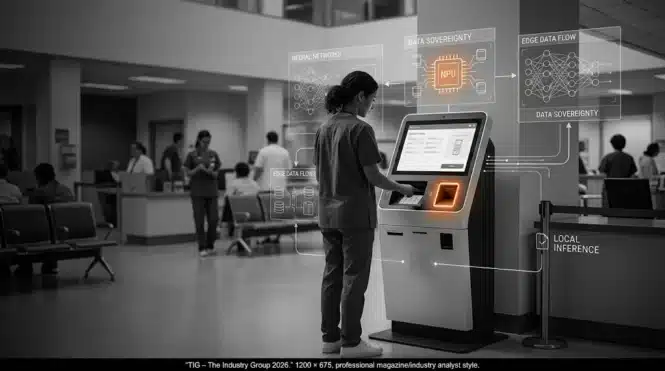
Local AI architecture shifts inference from remote hyperscale data centers onto industrial edge compute modules—such as Intel Core Ultra platforms running OpenVINO or dedicated embedded NPUs—housed inside the kiosk enclosure or on a local hospital floor server.
- Zero External ePHI Egress: Automatic speech recognition (ASR), multilingual translation, and OCR run locally in volatile memory; only structured, validated HL7/FHIR intake fields pass directly into the hospital’s internal HIS/EHR.
- No Third-Party AI Data Processors: Because patient audio and document images never leave hospital premises, operators dramatically shrink their vendor risk surface under India’s DPDP Act, PIPL, PDPA, GDPR, and HIPAA.
- Multilingual & Accessibility Support at the Edge: Local quantized models handle regional dialects, screen-reader voice guidance, and high-contrast adaptive UI prompts without cloud round-trip lag.
- Predictable TCO at Scale: Eliminating per-token and per-minute cloud API metering stabilizes operating budgets across hundreds of high-volume outpatient terminals.
Implementation Checklist for Hospital Kiosk Deployments
- Isolate Inference Workloads: Run containerized SLMs and OCR engines on dedicated local compute with disabled external telemetry and encrypted NVMe storage.
- Enforce Ephemeral Media Handling: Purge raw camera frames, voice buffers, and ID scans from RAM immediately after structured field extraction.
- Provide Non-Biometric Alternatives: Pair camera or voice workflows with QR/smartcard readers and tactile assistive keypads to satisfy accessibility rules and voluntary-consent laws.
- Audit Local Model Updates: Deliver signed model weights and security patches through managed on-premise MDM pipelines rather than unvetted public endpoints.
Frequently Asked Questions
Does running AI locally on a healthcare kiosk eliminate privacy compliance obligations?
No—hospitals still must obtain valid patient consent, enforce role-based access controls, and secure internal EHR integrations, but local inference eliminates third-party cloud AI processor exposure and cross-border data transfer risks.
What hardware is required to run local AI on a hospital check-in kiosk?
Modern commercial edge processors equipped with integrated NPUs or embedded GPUs (capable of 40–100 TOPS) comfortably run quantized speech-to-text, document OCR, and domain-specific small language models inside fanless medical-grade enclosures.
How does India’s DPDP Act affect cloud-connected self-service kiosks?
Under the DPDP Act, healthcare providers acting as Data Fiduciaries must secure clear, purpose-specific consent and ensure any Data Processors meet strict security and transfer rules—making on-premises edge processing the cleanest architectural path.
Download the Full Briefing: Read the complete global analysis covering Europe, APAC, India, and North America in Healthcare Kiosks, Edge AI and Patient Data Sovereignty (PDF).


